Organic structures and reactions practice
QCE Chemistry · Original practice questions with worked solutions
Practise naming, functional groups, isomerism and organic reaction pathways. Use structural evidence and reagent conditions to identify the change.
Key ideas
- Identify the highest-priority functional group, choose the appropriate parent chain and number it to give the required locants.
- Structural isomers have the same molecular formula but different connectivity. Geometric isomers differ in arrangement about a restricted rotation.
- For reaction pathways, track the functional group and carbon skeleton at each stage; include reagents and conditions where requested.
Worked example
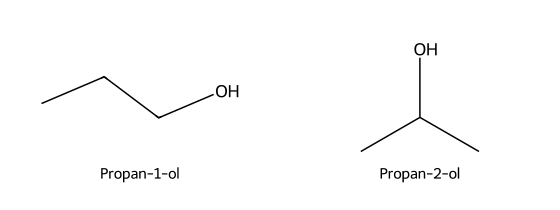
Propan-1-ol and propan-2-ol share but place the hydroxyl group on different carbon atoms.
A common mistake
A molecular formula alone does not identify a unique structure or functional group.
Try these questions
Attempt each question before revealing the worked solution. Saved questions and checked answers also appear in the main bank on this device. Exam marks are recorded after marking a practice exam.
Q17 · Practice questionSimple familiar1 mark
ANSWER
C
The carbonyl carbon is bonded directly to nitrogen, giving an amide.
Select C.
Q59 · Practice questionComplex familiar5 marks
QUESTION 59 (5 marks)
A liquid contains 60.0% carbon, 13.3% hydrogen and 26.7% oxygen by mass. Its molar mass is approximately 60.0 g mol⁻¹. Use atomic masses C = 12.0, H = 1.00, O = 16.0.
a) Determine its empirical and molecular formulas. [3 marks]
b) Give two alcohol structural isomers consistent with the molecular formula. [2 marks]
ANSWER
Empirical and molecular formula ; propan-1-ol and propan-2-ol.
For 100 g, mole amounts are 5.00 C, 13.3 H and 1.669 O. Divide by 1.669 to obtain approximately 3:8:1. The empirical mass is 60.0, so the molecular formula is the same. The hydroxyl group can be on carbon 1 or carbon 2.
Converts percentage masses to mole amounts.
Obtains empirical ratio 3:8:1.
Uses molar mass to confirm C₃H₈O.
Gives propan-1-ol structure/name.
Gives propan-2-ol structure/name.
Q60 · Practice questionSimple familiar4 marks
ANSWER
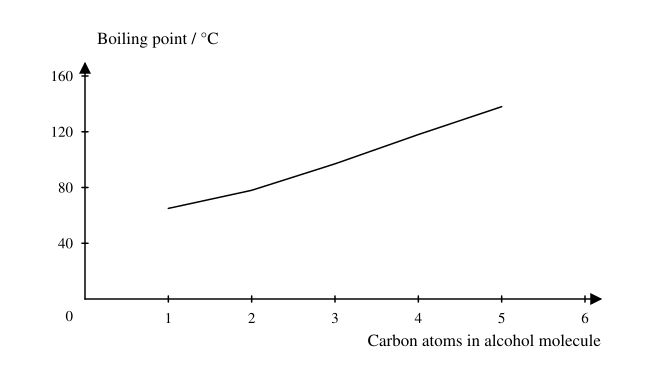
a) Increasing chain size strengthens dispersion attractions.
b) Ethanol forms intermolecular hydrogen bonds, unlike ethane.
Larger electron clouds are more polarisable and longer molecules offer greater contact area, strengthening dispersion forces. Alcohols also hydrogen-bond through O–H groups. Ethane has only dispersion attractions.
Connects increasing chain length to larger electron cloud/contact area.
Connects stronger dispersion forces to higher boiling point.
Identifies ethanol hydrogen bonding.
Contrasts with only dispersion attractions in ethane.
All organic structures and reactions practice questions
31 original questions · Page 1 of 2
- Q17 · Original practice · 1 markOrganic chemistryWhich functional group is present in the structure shown?
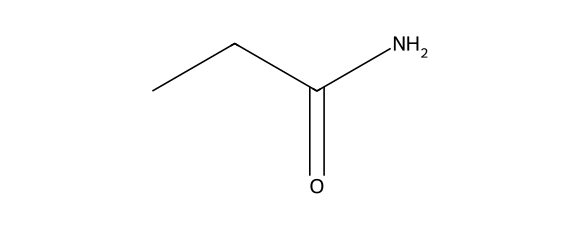
- Q18 · Original practice · 1 markOrganic chemistryWhat is the IUPAC name of ?
- Q19 · Original practice · 1 markOrganic chemistryWhich compound can show cis–trans isomerism?
- Q20 · Original practice · 1 markOrganic chemistryWhich compound contains a chiral carbon?
- Q21 · Original practice · 1 markOrganic chemistryPropene reacts with hydrogen bromide under conditions favouring the Markovnikov product. The major product is
- Q22 · Original practice · 1 markOrganic chemistryExcess acidified potassium dichromate is heated under reflux with propan-1-ol. The principal organic product is
- Q23 · Original practice · 1 markOrganic chemistryWhich pair forms ethyl methanoate by esterification?
- Q59 · Original practice · 5 marksOrganic chemistryA liquid contains 60.0% carbon, 13.3% hydrogen and 26.7% oxygen by mass. Its molar mass is approximately 60.0 g mol⁻¹. Use atomic masses C = 12.0, H = 1.00, O = 16.0.
- Q60 · Original practice · 4 marksOrganic chemistryThe graph gives approximate normal boiling points of the first five straight-chain primary alcohols.
- Q61 · Original practice · 5 marksOrganic chemistryThree non-cyclic alkane structures share the formula .
- Q62 · Original practice · 4 marksOrganic chemistryThe structures show two isomers of 1,2-dichloroethene.
- Q63 · Original practice · 3 marksOrganic chemistryThe displayed molecule is 2-bromobutane.
- Q64 · Original practice · 5 marksOrganic chemistryA two-step pathway converts but-1-ene into butan-2-one.
- Q65 · Original practice · 4 marksOrganic chemistryThree unlabelled vials contain hexane, hex-1-ene and hexan-1-ol. Small samples may be tested separately.
- Q66 · Original practice · 4 marksOrganic chemistrySeparate samples of butan-1-ol, butan-2-ol and 2-methylpropan-2-ol are heated with excess acidified potassium dichromate.
- Q67 · Original practice · 4 marksOrganic chemistryEthyl propanoate is warmed with dilute acid and excess water.
- Q68 · Original practice · 5 marksOrganic chemistryButan-1-ol and butan-2-one have similar molar masses but boiling points of approximately 118 °C and 80 °C respectively.
- Q90 · Original practice · 6 marksOrganic chemistryA pathway starts from 2-bromo-2-methylbutane. Heated ethanolic hydroxide gives predominantly 2-methylbut-2-ene. This alkene undergoes acid-catalysed hydration, giving the Markovnikov alcohol.
- Q95 · Original practice · 6 marksOrganic chemistryThe ester shown undergoes acid-catalysed hydrolysis. Its alcohol product is then heated with acidified dichromate.
- Q109 · Original practice · 1 markOrganic chemistryAn organic compound has empirical formula and molar mass . Use C = 12.0 and H = 1.0. What is its molecular formula?
- Q110 · Original practice · 1 markOrganic chemistryIn , the class and the characteristic functional group are respectively
- Q111 · Original practice · 1 markOrganic chemistryHow is the haloalkane classified?
- Q112 · Original practice · 1 markOrganic chemistryOne mole of hex-2-yne undergoes complete hydrogenation to hexane. How many moles of hydrogen are consumed?
- Q113 · Original practice · 1 markOrganic chemistryHow many distinct non-cyclic alkane structural isomers have molecular formula ?