Q95 · Practice questionComplex unfamiliar6 marks
QUESTION 95 (6 marks)
The ester shown undergoes acid-catalysed hydrolysis. Its alcohol product is then heated with acidified dichromate.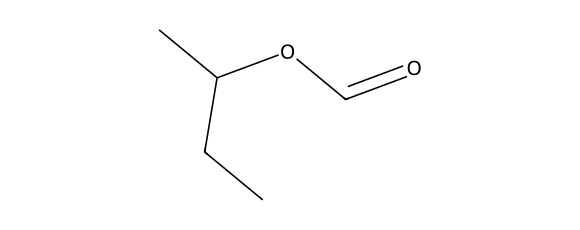
a) Name the two hydrolysis products. [2 marks]
b) Identify the chiral carbon in the alcohol and explain why it is chiral. [2 marks]
c) Name the oxidation product and explain whether the corresponding carbon remains chiral. [2 marks]
WORKED SOLUTION
6 marksPractice marking scheme
Methanoic acid and butan-2-ol; carbon 2 is chiral (H, OH, CH₃, CH₂CH₃). Oxidation gives butan-2-one; carbon 2 is trigonal planar and not chiral.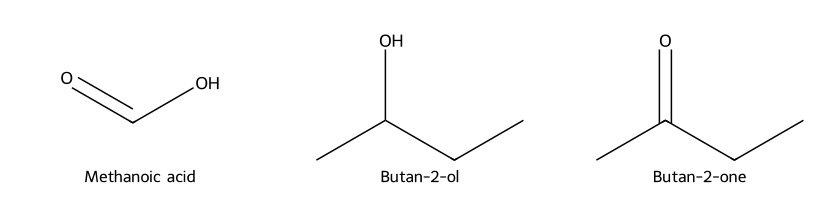
Hydrolysis splits the ester into its acid and alcohol residues. The secondary alcohol has four different groups at C2. Oxidation forms a carbonyl carbon, removing the tetrahedral stereocentre.
- Identifies methanoic acid. [1 marks]
- Identifies butan-2-ol. [1 marks]
- Identifies carbon 2. [1 marks]
- Lists/explains four different attached groups. [1 marks]
- Identifies butan-2-one. [1 marks]
- Explains carbonyl carbon is planar/not a four-group stereocentre. [1 marks]
Practice question aligned to the current QCAA syllabus; review the worked solution and marking criteria.
View the QCAA syllabusHow many marks did you earn?
Compare your working with the guide above.