QCEVault

Polymers and biomolecules practice

QCE Chemistry · Original practice questions with worked solutions

Practise polymer formation, carbohydrate structures and protein chemistry. Relate the repeat unit and bonds to the starting monomers.

Key ideas

  • Addition polymerisation opens suitable unsaturated bonds without forming a small-molecule by-product.
  • Condensation joins monomers while eliminating a small molecule such as water; hydrolysis can reverse suitable links.
  • Protein structure and amino-acid charge depend on bonding and conditions such as pH. Use the functional groups present.

Worked example

An amino acid amino group and a second amino acid carboxyl group can form a peptide link, releasing water.

A common mistake

A repeat unit is not an unchanged copy of the starting monomer: identify which bonds formed or opened during polymerisation.

Try these questions

Attempt each question before revealing the worked solution. Saved questions and checked answers also appear in the main bank on this device. Exam marks are recorded after marking a practice exam.

Q24 · Practice questionSimple familiar1 mark

QUESTION 24

Compared with LDPE, HDPE generally has
(A)
more branching and lower density.
(B)
more branching and higher density.
(C)
less branching and closer chain packing.
(D)
less branching and weaker intermolecular attractions.
Question link
Q69 · Practice questionSimple familiar4 marks

QUESTION 69 (4 marks)

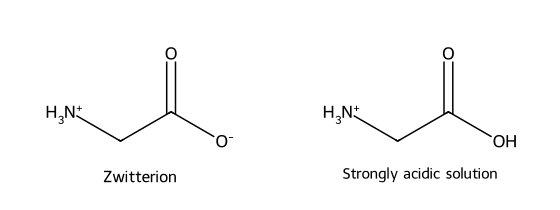
Glycine has the neutral structural formula H2NCH2COOH.

a) Draw its zwitterionic form in water near its isoelectric point. [2 marks]

b) Draw its predominant form in strongly acidic solution. [1 marks]

c) Explain why a zwitterion has zero net charge but is not uncharged at every site. [1 marks]

Question link
Q70 · Practice questionComplex familiar5 marks

QUESTION 70 (5 marks)

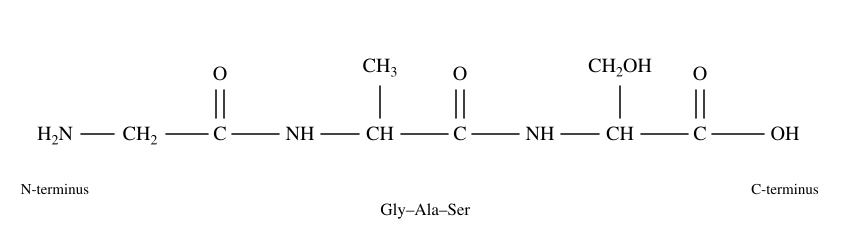
Use glycine H2NCH2COOH, alanine H2NCH(CH3)COOH and serine H2NCH(CH2OH)COOH to form the tripeptide Gly–Ala–Ser.

a) Draw the condensed structural formula with Gly at the N-terminus. [3 marks]

b) State the number of peptide bonds and water molecules released. [2 marks]
Question link

All polymers and biomolecules practice questions

13 original questions · Page 1 of 1

  1. Q24 · Original practice · 1 mark
    Compared with LDPE, HDPE generally has
    Polymers and biomolecules
  2. Q25 · Original practice · 1 mark
    A tripeptide is formed from three amino-acid molecules. How many peptide bonds and water molecules are formed?
    Polymers and biomolecules
  3. Q69 · Original practice · 4 marks
    Glycine has the neutral structural formula H2NCH2COOH\mathrm{H_2NCH_2COOH}.
    Polymers and biomolecules
  4. Q70 · Original practice · 5 marks
    Use glycine H2NCH2COOH\mathrm{H_2NCH_2COOH}, alanine H2NCH(CH3)COOH\mathrm{H_2NCH(CH_3)COOH} and serine H2NCH(CH2OH)COOH\mathrm{H_2NCH(CH_2OH)COOH} to form the tripeptide Gly–Ala–Ser.
    Polymers and biomolecules
  5. Q71 · Original practice · 4 marks
    Two glucose molecules, each C6H12O6\mathrm{C_6H_{12}O_6}, join to form the disaccharide maltose.
    Polymers and biomolecules
  6. Q72 · Original practice · 4 marks
    The two displayed monomers are used to make nylon-6,6.
    Polymers and biomolecules
  7. Q73 · Original practice · 3 marks
    Poly(lactic acid), PLA, has ester links in its backbone. Polyethene has a carbon–carbon backbone.
    Polymers and biomolecules
  8. Q74 · Original practice · 4 marks
    Two polypropene samples have identical chain lengths. In X, methyl groups follow a regular isotactic arrangement. In Y, they follow an irregular atactic arrangement.
    Polymers and biomolecules
  9. Q84 · Original practice · 4 marks
    Tetrafluoroethene, CF2=CF2\mathrm{CF_2=CF_2}, forms PTFE.
    Polymers and biomolecules
  10. Q114 · Original practice · 1 mark
    Which statement correctly describes a repeat unit of PTFE compared with a repeat unit of polyethene?
    Polymers and biomolecules
  11. Q149 · Original practice · 5 marks
    The diagram shows schematic methyl-group arrangements in three polypropene chains. Chain lengths and all other manufacturing conditions are the same.
    Polymers and biomolecules
  12. Q150 · Original practice · 5 marks
    The repeat unit of PLA is shown. PLA and polypropene are both used in manufactured products.
    Polymers and biomolecules
  13. Q151 · Original practice · 5 marks
    The diagrams show two cyclic forms of D-glucose. Both have formula C₆H₁₂O₆.
    Polymers and biomolecules