Q63 · Practice questionSimple familiar3 marks
QUESTION 63 (3 marks)
The displayed molecule is 2-bromobutane.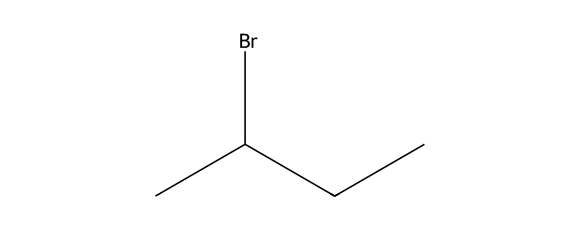
a) Identify its chiral carbon and list the four groups attached to that carbon. [2 marks]
b) State the relationship between its two optical isomers. [1 marks]
WORKED SOLUTION
3 marksPractice marking scheme
Carbon 2; H, Br, CH₃ and CH₂CH₃; non-superimposable mirror images (enantiomers).
The substituted carbon is tetrahedral and attached to four different groups. Its mirror-image arrangements cannot be superimposed.
- Identifies carbon 2. [1 marks]
- Lists all four distinct groups. [1 marks]
- States non-superimposable mirror-image relationship. [1 marks]
Practice question aligned to the current QCAA syllabus; review the worked solution and marking criteria.
View the QCAA syllabusHow many marks did you earn?
Compare your working with the guide above.