QCE Vault / Specialist Maths Motion and mechanics practice QCE Specialist Maths · Original practice questions with worked solutions
Browse all questions Complex numbers practice Vectors practice Proof and induction practice Matrices and models practice Integration and its applications practice Differential equations and related rates practice Motion and mechanics practice Statistical inference practice Original practice exam Practise displacement, velocity, acceleration and forces. Use a consistent coordinate direction and distinguish a vector from its magnitude.
Key ideas Velocity is the derivative of displacement, and acceleration is the derivative of velocity. For vector motion, differentiate each component.
Distance travelled is ∫ a b ∣ v ( t ) ∣ d t \int_a^b|v(t)|\,dt ∫ a b ∣ v ( t ) ∣ d t in one dimension. Split at changes of direction. Resolve all forces along the chosen axes before using ∑ F = m a \sum\mathbf F=m\mathbf a ∑ F = m a . Worked example For v ( t ) = 2 t − 2 v(t)=2t-2 v ( t ) = 2 t − 2 on 0 ≤ t ≤ 2 0\le t\le2 0 ≤ t ≤ 2 , displacement is zero but distance is ∫ 0 1 ( 2 − 2 t ) d t + ∫ 1 2 ( 2 t − 2 ) d t = 2 \int_0^1(2-2t)dt+\int_1^2(2t-2)dt=2 ∫ 0 1 ( 2 − 2 t ) d t + ∫ 1 2 ( 2 t − 2 ) d t = 2 . A common mistake Negative displacement is not negative distance. A change of direction can make distance larger than the magnitude of displacement.
Try these questions Attempt each question before revealing the worked solution. Saved questions and checked answers also appear in the main bank on this device. Exam marks are recorded after marking a practice exam.
Q83 · Practice question Simple familiar 1 mark
QUESTION 83 A 5 k g 5\ \mathrm{kg} 5 kg block is on a smooth plane inclined at 20 ∘ 20^\circ 2 0 ∘ . A 30 N 30\ \mathrm N 30 N force acts up the plane. Taking g = 9.8 m s − 2 g=9.8\ \mathrm{m\,s^{-2}} g = 9.8 m s − 2 , the acceleration up the plane is approximately (A) 1.35 m s − 2 1.35\ \mathrm{m\,s^{-2}} 1.35 m s − 2 (B) 2.65 m s − 2 2.65\ \mathrm{m\,s^{-2}} 2.65 m s − 2 (C) 3.42 m s − 2 3.42\ \mathrm{m\,s^{-2}} 3.42 m s − 2 (D) 5.88 m s − 2 5.88\ \mathrm{m\,s^{-2}} 5.88 m s − 2 Newton’s second law along the plane gives 5 a = 30 − 5 ( 9.8 ) sin 20 ∘ 5a=30-5(9.8)\sin20^\circ 5 a = 30 − 5 ( 9.8 ) sin 2 0 ∘ . Therefore a = 6 − 9.8 sin 20 ∘ ≈ 2.65 m s − 2 a=6-9.8\sin20^\circ\approx2.65\ \mathrm{m\,s^{-2}} a = 6 − 9.8 sin 2 0 ∘ ≈ 2.65 m s − 2 . Selects the correct option.
[1 mark] Q86 · Practice question Complex familiar 5 marks
QUESTION 86 (5 marks) A 3 k g 3\ \mathrm{kg} 3 kg particle moves along the x x x -axis under a force F = 6 x N F=6x\ \mathrm N F = 6 x N in the positive x x x direction. When x = 1 m x=1\ \mathrm m x = 1 m , its speed is 2 m s − 1 2\ \mathrm{m\,s^{-1}} 2 m s − 1 . a) Show that v 2 = 2 x 2 + 2 v^2=2x^2+2 v 2 = 2 x 2 + 2 . [3 marks] b) Determine the speed when x = 3 m x=3\ \mathrm m x = 3 m . [2 marks] ANSWER (a) v 2 = 2 x 2 + 2 v^2=2x^2+2 v 2 = 2 x 2 + 2 ; (b) 2 5 m s − 1 2\sqrt5\ \mathrm{m\,s^{-1}} 2 5 m s − 1 . (a) Newton’s second law gives 3 a = 6 x 3a=6x 3 a = 6 x , so a = 2 x a=2x a = 2 x . Using a = v d v / d x a=v\,dv/dx a = v d v / d x , v d v d x = 2 x ⇒ 1 2 v 2 = x 2 + C . v\frac{dv}{dx}=2x\quad\Rightarrow\quad\frac12v^2=x^2+C. v d x d v = 2 x ⇒ 2 1 v 2 = x 2 + C . With v 2 = 4 v^2=4 v 2 = 4 at x = 1 x=1 x = 1 , 2 = 1 + C 2=1+C 2 = 1 + C , giving C = 1 C=1 C = 1 . Hence v 2 = 2 x 2 + 2 v^2=2x^2+2 v 2 = 2 x 2 + 2 . (b) At x = 3 x=3 x = 3 , v 2 = 20 v^2=20 v 2 = 20 . The speed is ∣ v ∣ = 20 = 2 5 m s − 1 |v|=\sqrt{20}=2\sqrt5\ \mathrm{m\,s^{-1}} ∣ v ∣ = 20 = 2 5 m s − 1 . Uses Newton’s second law to find acceleration.
[1 mark] Integrates using v d v / d x v\,dv/dx v d v / d x . [1 mark] Applies the initial condition.
[1 mark] Q88 · Practice question Complex familiar 5 marks
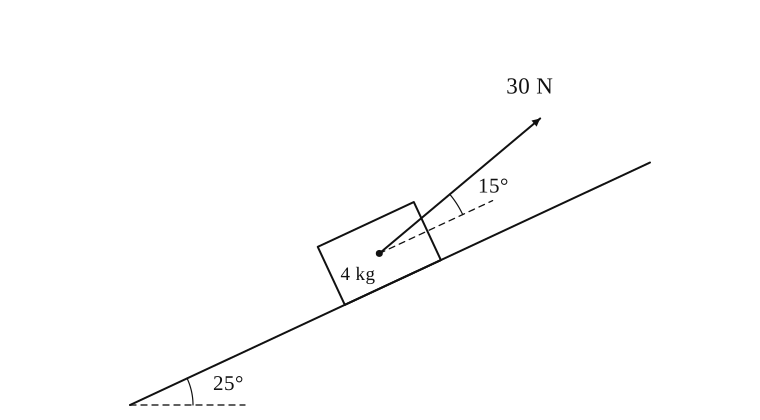
QUESTION 88 (5 marks) A 4 k g 4\ \mathrm{kg} 4 kg block is on a smooth plane inclined at 25 ∘ 25^\circ 2 5 ∘ to the horizontal. A 30 N 30\ \mathrm N 30 N force acts at 15 ∘ 15^\circ 1 5 ∘ above the plane in the uphill direction. Take g = 9.8 m s − 2 g=9.8\ \mathrm{m\,s^{-2}} g = 9.8 m s − 2 . a) Determine the acceleration of the block along the plane.
[3 marks] b) If the block starts from rest, determine the distance travelled along the plane in the first 3 s.
[2 marks] ANSWER (a) 3.103 m s − 2 3.103\ \mathrm{m\,s^{-2}} 3.103 m s − 2 uphill; (b) 13.96 m 13.96\ \mathrm m 13.96 m . (a) Taking uphill as positive, the net force along the plane is 30 cos 15 ∘ − 4 ( 9.8 ) sin 25 ∘ 30\cos15^\circ-4(9.8)\sin25^\circ 30 cos 1 5 ∘ − 4 ( 9.8 ) sin 2 5 ∘ . Therefore a = 30 cos 15 ∘ − 39.2 sin 25 ∘ 4 ≈ 3.103 m s − 2 a=\frac{30\cos15^\circ-39.2\sin25^\circ}{4}\approx3.103\ \mathrm{m\,s^{-2}} a = 4 30 cos 1 5 ∘ − 39.2 sin 2 5 ∘ ≈ 3.103 m s − 2 uphill. (b) With constant acceleration and initial speed zero, s = 1 2 a t 2 = 1 2 a ( 3 ) 2 ≈ 13.96 m . s=\frac12at^2=\frac12a(3)^2\approx13.96\ \mathrm m. s = 2 1 a t 2 = 2 1 a ( 3 ) 2 ≈ 13.96 m . Resolves forces along the plane.
[1 mark] Applies Newton’s second law.
[1 mark] Uses the constant-acceleration relation.
[1 mark] All motion and mechanics practice questions 25 original questions · Page 1 of 2
Q83 · Original practice · 1 mark A 5 k g 5\ \mathrm{kg} 5 kg block is on a smooth plane inclined at 20 ∘ 20^\circ 2 0 ∘ . A 30 N 30\ \mathrm N 30 N force acts up the plane. Taking g = 9.8 m s − 2 g=9.8\ \mathrm{m\,s^{-2}} g = 9.8 m s − 2 , the acceleration up the plane is approximately Mechanics Q85 · Original practice · 1 mark A particle satisfies v d v / d x = 3 x v\,dv/dx=3x v d v / d x = 3 x and v = 2 v=2 v = 2 when x = 0 x=0 x = 0 . When x = 2 x=2 x = 2 , its speed is Mechanics Q86 · Original practice · 5 marks A 3 k g 3\ \mathrm{kg} 3 kg particle moves along the x x x -axis under a force F = 6 x N F=6x\ \mathrm N F = 6 x N in the positive x x x direction. When x = 1 m x=1\ \mathrm m x = 1 m , its speed is 2 m s − 1 2\ \mathrm{m\,s^{-1}} 2 m s − 1 . Mechanics Q87 · Original practice · 1 mark A particle in SHM satisfies v 2 = 25 ( A 2 − x 2 ) v^2=25(A^2-x^2) v 2 = 25 ( A 2 − x 2 ) . If x = 3 x=3 x = 3 when ∣ v ∣ = 20 |v|=20 ∣ v ∣ = 20 , the amplitude A A A is Mechanics Q88 · Original practice · 5 marks A 4 k g 4\ \mathrm{kg} 4 kg block is on a smooth plane inclined at 25 ∘ 25^\circ 2 5 ∘ to the horizontal. A 30 N 30\ \mathrm N 30 N force acts at 15 ∘ 15^\circ 1 5 ∘ above the plane in the uphill direction. Take g = 9.8 m s − 2 g=9.8\ \mathrm{m\,s^{-2}} g = 9.8 m s − 2 . Mechanics Q89 · Original practice · 1 mark A vertical-motion model uses d v / d t = − 9.8 − 0.4 v dv/dt=-9.8-0.4v d v / d t = − 9.8 − 0.4 v , where upward velocity is positive. The terminal speed is Mechanics Q90 · Original practice · 7 marks A particle satisfies d 2 x d t 2 = − 4 x , x ( 0 ) = 3 , v ( 0 ) = − 4. \frac{d^2x}{dt^2}=-4x,\qquad x(0)=3,\qquad v(0)=-4. d t 2 d 2 x = − 4 x , x ( 0 ) = 3 , v ( 0 ) = − 4. Mechanics Q92 · Original practice · 7 marks A ball is projected vertically upward with speed 20 m s − 1 20\ \mathrm{m\,s^{-1}} 20 m s − 1 . Its velocity satisfies d v d t = − 10 − 0.5 v , \frac{dv}{dt}=-10-0.5v, d t d v = − 10 − 0.5 v , where upward is positive and t t t is in seconds. Mechanics Q123 · Original practice · 5 marks A particle has acceleration a ( t ) = 4 t − 6 a(t)=4t-6 a ( t ) = 4 t − 6 , with v ( 0 ) = 2 v(0)=2 v ( 0 ) = 2 and x ( 0 ) = 1 x(0)=1 x ( 0 ) = 1 . Mechanics Q126 · Original practice · 6 marks A particle at P = ( 2 , − 1 , 1 ) P=(2,-1,1) P = ( 2 , − 1 , 1 ) moves with direction d = ( 1 , 2 , − 2 ) d=(1,2,-2) d = ( 1 , 2 , − 2 ) and reflects from the plane 2 x − y + 2 z = 3 2x-y+2z=3 2 x − y + 2 z = 3 . Reflection reverses the normal component of d d d . Mechanics Q131 · Original practice · 1 mark Forces 30 N 30\,\mathrm{N} 30 N east, 20 N 20\,\mathrm{N} 20 N north and 10 N 10\,\mathrm{N} 10 N west have resultant Mechanics Q145 · Original practice · 7 marks A particle executes SHM with x ( t ) = 0.12 cos ( 4 t − π 3 ) x(t)=0.12 \cos (4t-\frac{\pi}{3}) x ( t ) = 0.12 cos ( 4 t − 3 π ) metres. Mechanics Q146 · Original practice · 7 marks A 2.0 k g 2.0\,\mathrm{kg} 2.0 kg particle moves in the x y xy x y -plane under force F = ( 6 − 2 t ) i + ( 4 t ) j N F=(6-2t)i+(4t)j\,\mathrm{N} F = ( 6 − 2 t ) i + ( 4 t ) j N . At t = 0 t=0 t = 0 its velocity is 3 i − j m s − 1 3i-j\,\mathrm{m}\,\mathrm{s}^{-1} 3 i − j m s − 1 and position is the origin. Mechanics Q158 · Original practice · 6 marks A trolley moves on a straight track for 0 ≤ t ≤ 4 0\le t\le4 0 ≤ t ≤ 4 seconds. Its velocity, in metres per second, is v ( t ) = t 2 − 4 t + 3. v(t)=t^2-4t+3. v ( t ) = t 2 − 4 t + 3. The velocity-time graph is shown. The trolley starts at position x ( 0 ) = 0 x(0)=0 x ( 0 ) = 0 . Modelling motion: displacement and distance Q222 · Original practice · 6 marks A particle has acceleration a = − 2 x a=-2x a = − 2 x m/s squared. At x=0 it moves in the positive direction with speed 4 m/s. Modelling motion Q223 · Original practice · 5 marks A robot antenna vibrates with displacement x ( t ) = 3 cos 2 t + 4 sin 2 t x(t)=3\cos2t+4\sin2t x ( t ) = 3 cos 2 t + 4 sin 2 t cm for t nonnegative. Modelling motion Q224 · Original practice · 7 marks A falling object has downward velocity satisfying d v / d t = 10 − 2 v dv/dt=10-2v d v / d t = 10 − 2 v , v(0)=0. Its downward displacement starts at zero. Modelling motion Q225 · Original practice · 10 marks An object is thrown upwards with v(0)=10 m/s. Upwards is positive. Linear air resistance gives d v / d t = − 10 − v dv/dt=-10-v d v / d t = − 10 − v throughout flight; h(0)=0. Modelling motion Q226 · Original practice · 5 marks A 2 kg block is projected up a smooth plane at 6 m/s. The plane is inclined at 30 degrees to horizontal. Take g=10 m/s squared and up-plane displacement positive.
Modelling motion Q227 · Original practice · 5 marks On a frictionless arcade track, a 2 kg cart moves right at 6 m/s and a 1 kg cart moves left at 3 m/s. They collide and remain joined. External impulse is negligible.
Modelling motion Q228 · Original practice · 5 marks A 2 kg particle moves in positive x under resultant force F(x)=6x N, starting from rest at x=1 m.
Modelling motion Q255 · Original practice · 12 marks In a magnetic-launch simulation, a particle moves on a straight track with acceleration a ( x ) = − 20 / ( 1 + x ) 2 a(x)=-20/(1+x)^2 a ( x ) = − 20/ ( 1 + x ) 2 m/s 2 ^2 2 for x ≥ 0 x\ge0 x ≥ 0 . It starts at x = 0 x=0 x = 0 with positive speed v 0 v_0 v 0 . The acceleration depends only on position and applies on both outward and return motion, whenever a return occurs. Modelling motion Q270 · Original practice · 6 marks A 4 kg block is initially at rest on a smooth plane inclined at 30 ∘ 30^\circ 3 0 ∘ above the horizontal. A rope pulls at 20 ∘ 20^\circ 2 0 ∘ above the plane with tension 18 N. Use g = 10 g=10 g = 10 m s − 2 ^{-2} − 2 . The stimulus shows the geometry only; it contains no force arrows. Modelling motion Q280 · Original practice · 6 marks A trolley has acceleration a ( t ) = 6 − 2 t a(t)=6-2t a ( t ) = 6 − 2 t m s − 2 ^{-2} − 2 for 0 ≤ t ≤ 6 0\le t\le6 0 ≤ t ≤ 6 s and initial velocity v ( 0 ) = − 5 v(0)=-5 v ( 0 ) = − 5 m s − 1 ^{-1} − 1 . The acceleration graph is supplied. Modelling motion