∣d∣2=9 and ∣9(25,10,−2)∣2=81625+100+4=9, so magnitude is preserved.
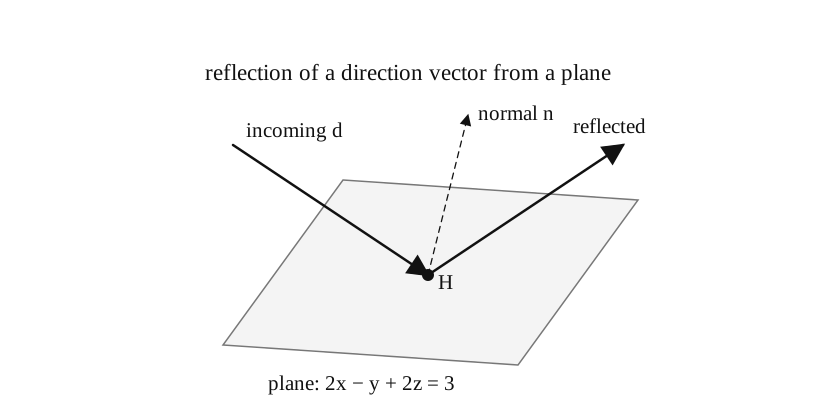
Part (a): On P+td=(2+t,−1+2t,1−2t), the plane expression is 7−4t. Set 7−4t=3→t=1, so the impact point is H=(3,1,−1).
Part (b): With normal n=(2,−1,2),d⋅n=−4 and n⋅n=9. The reflected vector is d−n⋅n2(d⋅n)n=d+(98)n=9(25,10,−2), so (25,10,−2) is a direction vector.
Part (c): ∣d∣2=9 and ∣9(25,10,−2)∣2=81625+100+4=9, so magnitude is preserved.
Editorial practice rubric; not an official QCAA marking scheme. Equivalent correct methods are accepted. Method marks may be awarded after an earlier arithmetic error when the subsequent method is valid.
Part (a): Substitutes (2+t,−1+2t,1−2t) into the plane and solves 7−4t=3 for t=1.
[1 mark]
Part (a): Gives the impact point (3,1,−1).
[1 mark]
Part (b): Identifies a plane normal n=(2,−1,2) and calculates d⋅n=−4, n⋅n=9.
[1 mark]
Part (b): Uses reflection dr=d−2(d⋅n)n/(n⋅n) or equivalent normal-component reversal.
[1 mark]
Part (b): Obtains dr=(25,10,−2)/9; any positive scalar multiple is accepted as a direction vector.
[1 mark]
Part (c): Verifies ∣(25,10,−2)/9∣2=9=∣d∣2, using the reflected velocity with its original scale.