Q224 · Practice questionTechnology-activeComplex familiar7 marks
QUESTION 224 (7 marks)
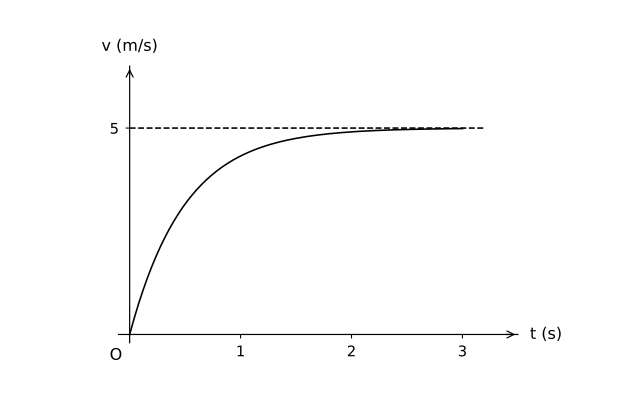
A falling object has downward velocity satisfying , v(0)=0. Its downward displacement starts at zero.
a)[3 marks]
Determine velocity and terminal velocity.
b)[2 marks]
Determine displacement.
c)[2 marks]
When does it first reach 95 percent of terminal speed?
ANSWER
(a) ; terminal m/s.
(b) .
(c) s.
(a) Separating and integrating gives . The initial condition gives C=10, yielding the stated velocity. Its limit is 5, approached asymptotically.
(b) Integrating v gives . Applying s(0)=0 gives C=-5/2.
(c) Set , so exp(-2t)=0.05 and t=ln20/2. Velocity increases strictly, making this the first attainment.
Equivalent mathematically justified methods accepted.
Exact answers unless a decimal accuracy is specified.
Part a: Separate and integrate.
Part a: Apply v(0)=0.
Part a: Find terminal velocity.
Part b: Integrate velocity.
Part b: Apply the initial displacement.
Part c: Form the terminal-speed fraction equation.
Part c: Give exact time and decimal, with first-time justification.