QCE Vault / Specialist Maths Differential equations and related rates practice QCE Specialist Maths · Original practice questions with worked solutions
Browse all questions Complex numbers practice Vectors practice Proof and induction practice Matrices and models practice Integration and its applications practice Differential equations and related rates practice Motion and mechanics practice Statistical inference practice Original practice exam Practise differential equations, slope fields, implicit differentiation and related rates. State the dependent variables and use initial conditions to determine constants.
Key ideas A separable equation d y / d x = g ( x ) h ( y ) dy/dx=g(x)h(y) d y / d x = g ( x ) h ( y ) can be rearranged to d y / h ( y ) = g ( x ) d x dy/h(y)=g(x)\,dx d y / h ( y ) = g ( x ) d x where this division is allowed. Check any excluded constant solutions. For related rates, write a relation between the changing quantities and differentiate with respect to the same time variable.
A slope field shows the derivative at each point. A solution curve must follow those slopes and pass through its initial point.
Worked example If d y / d t = − 2 y dy/dt=-2y d y / d t = − 2 y and y ( 0 ) = 3 y(0)=3 y ( 0 ) = 3 , then y = C e − 2 t y=Ce^{-2t} y = C e − 2 t and the initial condition gives y = 3 e − 2 t y=3e^{-2t} y = 3 e − 2 t . A common mistake An indefinite integration constant must be determined using the initial condition; it is not automatically zero.
Try these questions Attempt each question before revealing the worked solution. Saved questions and checked answers also appear in the main bank on this device. Exam marks are recorded after marking a practice exam.
Q71 · Practice question Simple familiar 1 mark
QUESTION 71 The curve x 2 + x y + 2 y 2 = 8 x^2+xy+2y^2=8 x 2 + x y + 2 y 2 = 8 passes through ( 2 , 1 ) (2,1) ( 2 , 1 ) . The gradient there is Implicit differentiation gives 2 x + y + ( x + 4 y ) y ′ = 0 2x+y+(x+4y)y^{\prime}=0 2 x + y + ( x + 4 y ) y ′ = 0 . At ( 2 , 1 ) (2,1) ( 2 , 1 ) , y ′ = − ( 4 + 1 ) / ( 2 + 4 ) = − 5 / 6 y^{\prime}=-(4+1)/(2+4)=-5/6 y ′ = − ( 4 + 1 ) / ( 2 + 4 ) = − 5/6 . Selects the correct option.
[1 mark] Q74 · Practice question Complex familiar 5 marks
QUESTION 74 (5 marks) The curve x 2 y + y 3 = 10 x^2y+y^3=10 x 2 y + y 3 = 10 passes through ( 1 , 2 ) (1,2) ( 1 , 2 ) . a) Use implicit differentiation to obtain d y / d x dy/dx d y / d x in terms of x x x and y y y . [2 marks] b) Determine the equation of the tangent at ( 1 , 2 ) (1,2) ( 1 , 2 ) . [2 marks] c) Determine the acute angle the tangent makes with the horizontal, to the nearest 0.1 ∘ 0.1^\circ 0. 1 ∘ . [1 mark] ANSWER (a) − 2 x y / ( x 2 + 3 y 2 ) -2xy/(x^2+3y^2) − 2 x y / ( x 2 + 3 y 2 ) ; (b) y − 2 = − 4 ( x − 1 ) / 13 y-2=-4(x-1)/13 y − 2 = − 4 ( x − 1 ) /13 ; (c) 17.1 ∘ 17.1^\circ 17. 1 ∘ . (a) Differentiating implicitly gives 2 x y + x 2 y ′ + 3 y 2 y ′ = 0 ⇒ y ′ = − 2 x y x 2 + 3 y 2 . 2xy+x^2y^{\prime}+3y^2y^{\prime}=0\quad\Rightarrow\quad y^{\prime}=-\frac{2xy}{x^2+3y^2}. 2 x y + x 2 y ′ + 3 y 2 y ′ = 0 ⇒ y ′ = − x 2 + 3 y 2 2 x y . (b) At ( 1 , 2 ) (1,2) ( 1 , 2 ) , m = − 4 / 13 m=-4/13 m = − 4/13 . Therefore the tangent is y − 2 = − 4 13 ( x − 1 ) y-2=-\frac4{13}(x-1) y − 2 = − 13 4 ( x − 1 ) . (c) The acute angle is tan − 1 ( ∣ m ∣ ) = tan − 1 ( 4 / 13 ) ≈ 17.1 ∘ \tan^{-1}(|m|)=\tan^{-1}(4/13)\approx17.1^\circ tan − 1 ( ∣ m ∣ ) = tan − 1 ( 4/13 ) ≈ 17. 1 ∘ . Obtains the implicit derivative.
[2 marks] Determines the gradient and tangent equation.
[2 marks] Determines the acute angle.
[1 mark] Q76 · Practice question Complex familiar 5 marks
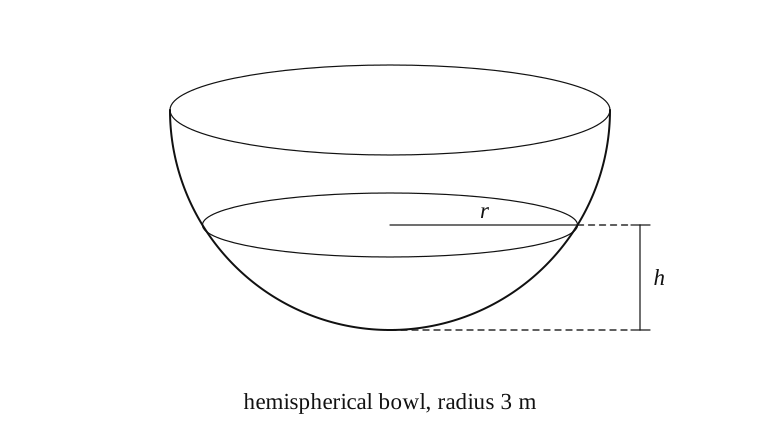
QUESTION 76 (5 marks) Water in a hemispherical bowl of radius R = 3 m R=3\ \mathrm m R = 3 m has depth h m h\ \mathrm m h m . The volume of water is V = π h 2 ( R − h 3 ) . V=\pi h^2\left(R-\frac h3\right). V = π h 2 ( R − 3 h ) . Water is entering at 0.5 m 3 m i n − 1 0.5\ \mathrm{m^3\,min^{-1}} 0.5 m 3 mi n − 1 . Determine d h / d t dh/dt d h / d t when h = 1 m h=1\ \mathrm m h = 1 m . ANSWER d h / d t = 1 / ( 10 π ) m m i n − 1 dh/dt=1/(10\pi)\ \mathrm{m\,min^{-1}} d h / d t = 1/ ( 10 π ) m mi n − 1 . With R = 3 R=3 R = 3 , V = π ( 3 h 2 − h 3 3 ) , d V d h = π ( 6 h − h 2 ) . V=\pi\left(3h^2-\frac{h^3}{3}\right),\qquad\frac{dV}{dh}=\pi(6h-h^2). V = π ( 3 h 2 − 3 h 3 ) , d h d V = π ( 6 h − h 2 ) . The chain rule gives d V d t = π ( 6 h − h 2 ) d h d t . \frac{dV}{dt}=\pi(6h-h^2)\frac{dh}{dt}. d t d V = π ( 6 h − h 2 ) d t d h . At h = 1 h=1 h = 1 , 0.5 = 5 π d h d t ⇒ d h d t = 1 10 π m m i n − 1 . 0.5=5\pi\frac{dh}{dt}\quad\Rightarrow\quad\frac{dh}{dt}=\frac1{10\pi}\ \mathrm{m\,min^{-1}}. 0.5 = 5 π d t d h ⇒ d t d h = 10 π 1 m mi n − 1 . Differentiates volume with respect to depth.
[2 marks] Substitutes the rate and depth.
[1 mark] Determines the rate of change of depth.
[1 mark] All differential equations and related rates practice questions 36 original questions · Page 1 of 2
Q71 · Original practice · 1 mark The curve x 2 + x y + 2 y 2 = 8 x^2+xy+2y^2=8 x 2 + x y + 2 y 2 = 8 passes through ( 2 , 1 ) (2,1) ( 2 , 1 ) . The gradient there is Differential equations Q73 · Original practice · 1 mark The volume of a sphere is increasing at 36 π c m 3 s − 1 36\pi\ \mathrm{cm^3\,s^{-1}} 36 π c m 3 s − 1 . When the radius is 3 c m 3\ \mathrm{cm} 3 cm , d r / d t dr/dt d r / d t is Differential equations Q74 · Original practice · 5 marks The curve x 2 y + y 3 = 10 x^2y+y^3=10 x 2 y + y 3 = 10 passes through ( 1 , 2 ) (1,2) ( 1 , 2 ) . Differential equations Q75 · Original practice · 1 mark The solution of d y / d x = 2 x y dy/dx=2xy d y / d x = 2 x y with y ( 0 ) = 3 y(0)=3 y ( 0 ) = 3 has y ( 1 ) y(1) y ( 1 ) equal to Differential equations Q76 · Original practice · 5 marks Water in a hemispherical bowl of radius R = 3 m R=3\ \mathrm m R = 3 m has depth h m h\ \mathrm m h m . The volume of water is V = π h 2 ( R − h 3 ) . V=\pi h^2\left(R-\frac h3\right). V = π h 2 ( R − 3 h ) . Water is entering at 0.5 m 3 m i n − 1 0.5\ \mathrm{m^3\,min^{-1}} 0.5 m 3 mi n − 1 . Determine d h / d t dh/dt d h / d t when h = 1 m h=1\ \mathrm m h = 1 m . Differential equations Q77 · Original practice · 1 mark For d y / d x = ( y − 1 ) ( 3 − y ) dy/dx=(y-1)(3-y) d y / d x = ( y − 1 ) ( 3 − y ) with 1 < y ( 0 ) < 3 1<y(0)<3 1 < y ( 0 ) < 3 , the solution approaches Differential equations Q78 · Original practice · 7 marks A population P P P satisfies d P d t = 0.3 P ( 1 − P 500 ) , P ( 0 ) = 50. \frac{dP}{dt}=0.3P\left(1-\frac P{500}\right),\qquad P(0)=50. d t d P = 0.3 P ( 1 − 500 P ) , P ( 0 ) = 50. Differential equations Q79 · Original practice · 1 mark A cooling model is T = 20 + 60 e − 0.2 t T=20+60e^{-0.2t} T = 20 + 60 e − 0.2 t , with t t t in minutes. The time when T = 30 T=30 T = 30 is approximately Differential equations Q80 · Original practice · 6 marks An object cools in a room maintained at 22 ∘ C 22^\circ\mathrm C 2 2 ∘ C . Its temperature T T T satisfies Newton’s law of cooling. Initially T = 90 ∘ C T=90^\circ\mathrm C T = 9 0 ∘ C , and after 10 minutes T = 60 ∘ C T=60^\circ\mathrm C T = 6 0 ∘ C . Differential equations Q81 · Original practice · 1 mark A substance has a half-life of 12 hours. The proportion remaining after 30 hours is approximately
Differential equations Q82 · Original practice · 6 marks A radioactive sample initially has mass 120 m g 120\ \mathrm{mg} 120 mg . After 8 days its mass is 90 m g 90\ \mathrm{mg} 90 mg . Assume exponential decay. Differential equations Q84 · Original practice · 5 marks The differential equation is d y d x = x ( 1 + y ) , y ( 0 ) = 0. \frac{dy}{dx}=x(1+y),\qquad y(0)=0. d x d y = x ( 1 + y ) , y ( 0 ) = 0. Differential equations Q106 · Original practice · 6 marks A curve satisfies d y d x = x 1 + y 2 , y ( 0 ) = 0. \frac{dy}{dx}=\frac{x}{1+y^2},\qquad y(0)=0. d x d y = 1 + y 2 x , y ( 0 ) = 0. Differential equations Q115 · Original practice · 1 mark For d y d x = ( x + 2 ) ( y − 3 ) \frac{\mathrm{d}y}{\mathrm{d}x}=(x+2)(y-3) d x d y = ( x + 2 ) ( y − 3 ) , zero slope occurs on Differential equations Q128 · Original practice · 6 marks A curve satisfies d y d x = 2 x + 1 y − 1 \frac{\mathrm{d}y}{\mathrm{d}x}=\frac{2x+1}{y-1} d x d y = y − 1 2 x + 1 and passes through ( 0 , 3 ) (0,3) ( 0 , 3 ) . Differential equations Q136 · Original practice · 1 mark For d P d t = 0.3 P ( 1 − P 50 ) \frac{\mathrm{d}P}{\mathrm{d}t}=0.3P(1-\frac{P}{50}) d t d P = 0.3 P ( 1 − 50 P ) , the positive equilibrium is Differential equations Q143 · Original practice · 6 marks A population satisfies d P d t = 0.4 P ( 1 − P 80 ) \frac{\mathrm{d}P}{\mathrm{d}t}=0.4P(1-\frac{P}{80}) d t d P = 0.4 P ( 1 − 80 P ) , with P ( 0 ) = 20 P(0)=20 P ( 0 ) = 20 . Differential equations Q152 · Original practice · 8 marks A population is modelled as a continuous quantity N ( t ) N(t) N ( t ) , where t t t is measured in days. It satisfies d N d t = k N ( K − N ) , k > 0 , K > 0. \frac{dN}{dt}=kN(K-N),\qquad k>0,\quad K>0. d t d N = k N ( K − N ) , k > 0 , K > 0. The graph shows the growth rate as a function of population. The axis intercepts and the labelled point P are exact. Initially, N ( 0 ) = 50 N(0)=50 N ( 0 ) = 50 . Rates of change and differential equations Q160 · Original practice · 7 marks A metal block cools according to
d T d t = − k ( T − A ) , \frac{dT}{dt}=-k(T-A), d t d T = − k ( T − A ) , where T T T and the surrounding temperature A A A are in degrees Celsius, t t t is in minutes and k > 0 k>0 k > 0 is constant.
Initially T ( 0 ) = 100 T(0)=100 T ( 0 ) = 100 and A = 20 A=20 A = 20 . At t = 10 t=10 t = 10 , T = 60 T=60 T = 60 . At that instant the block is moved to a room at A = 10 A=10 A = 10 . The block's temperature is continuous at the move and k k k is unchanged. The d… Differential equations: piecewise cooling Q162 · Original practice · 9 marks An inverted conical tank has height 6 6 6 m and top radius 3 3 3 m. Water depth above the vertex is h h h metres, and the radius of its surface is r r r metres. Water enters at 6 π 6\pi 6 π cubic metres per minute and leaves at 2 π h 2\pi h 2 π h cubic metres per minute. Initially h ( 0 ) = 4 h(0)=4 h ( 0 ) = 4 . Assume the model applies for 0 < h < 6 0<h<6 0 < h < 6 . Rates of change and differential equations: conical tank Q169 · Original practice · 8 marks A function satisfies
d y d x = x ( 1 − y 2 ) , y ( 0 ) = 0. \frac{dy}{dx}=x(1-y^2),\qquad y(0)=0. d x d y = x ( 1 − y 2 ) , y ( 0 ) = 0. A slope field for this equation is shown. Consider the solution on − 2 ≤ x ≤ 2 -2\le x\le2 − 2 ≤ x ≤ 2 . Differential equations: slope field and separation Q170 · Original practice · 8 marks A spherical ice shell surrounds a rigid spherical core of radius 3 3 3 cm. The outer radius is initially 5 5 5 cm. Ice volume is lost at a constant rate of 6 π 6\pi 6 π cubic centimetres per minute. Melting occurs only at the outer surface, and the core remains unchanged. Let r ( t ) r(t) r ( t ) be the outer radius, in centimetres. The diagram is a central cross-section. Related rates: melting spherical shell Q218 · Original practice · 10 marks A managed algae population satisfies N ′ = N ( 1 − N / 100 ) − 16 N^{\prime}=N(1-N/100)-16 N ′ = N ( 1 − N /100 ) − 16 for N ≥ 0 N\ge0 N ≥ 0 . The model stops at extinction N=0. The graph shows growth rate against population. Differential equations and related rates Q219 · Original practice · 6 marks A population satisfies N ′ = k N ( 120 − N ) N'=kN(120-N) N ′ = k N ( 120 − N ) with k>0, N(0)=30 and N(4)=60. Time is in days. Differential equations and related rates