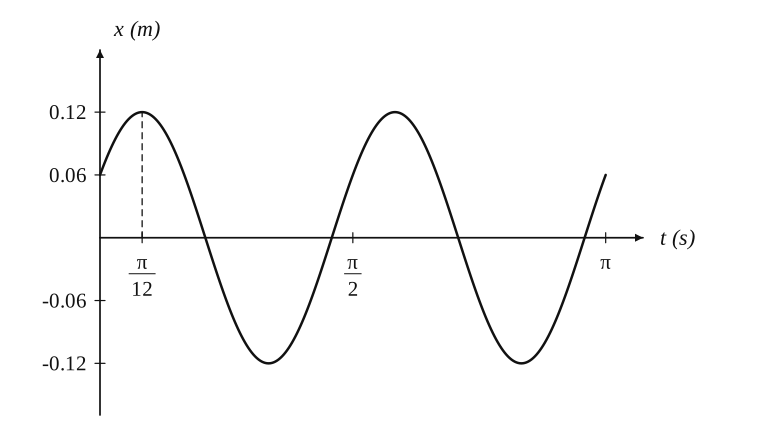
Maximum when 4t−3π=0mod2π; first positive t=12πs.
Part (a): Amplitude=0.12m; period=42π=2πs.
Part (b): v=−0.48sin(4t−3π)ms−1; maximum speed=0.48ms−1.
Part (c): For SHM a=−ω2x=−16(0.060)=−0.960ms−2.
Part (d): Maximum when 4t−3π=0mod2π; first positive t=12πs.
Editorial practice rubric; not an official QCAA marking scheme. Equivalent correct methods are accepted. Method marks may be awarded after an earlier arithmetic error when the subsequent method is valid.
Part (a): States the amplitude 0.12m.
[1 mark]
Part (a): Calculates T=2π/4=π/2s.
[1 mark]
Part (b): Differentiates to v(t)=−0.48sin(4t−π/3)ms−1.
[1 mark]
Part (b): States maximum speed 0.48ms−1.
[1 mark]
Part (c): Uses the SHM relation a=−ω2x=−16x.
[1 mark]
Part (c): Obtains a=−0.960ms−2 at the given displacement.
[1 mark]
Part (d): Solves the first maximum condition 4t−π/3=0 to obtain t=π/12s.