QCEVault

Genetics and heredity practice

QCE Biology · Original practice questions with worked solutions

Practise inheritance, DNA, gene expression and interpreting biological evidence. Establish the inheritance model and what the data actually show before calculating ratios or drawing conclusions.

Key ideas

  • Genotype describes the alleles present; phenotype describes the expressed characteristics and can be influenced by the environment.
  • Meiosis separates homologous chromosomes and produces haploid cells. Independent assortment and crossing over contribute to genetic variation.
  • For a stated simple Mendelian model, use parental genotypes to determine possible gametes and offspring probabilities.

Worked example

For an Aa×AaAa\times Aa cross with complete dominance, the genotype probabilities are 1/41/4 AA, 1/21/2 Aa and 1/41/4 aa. The expected dominant-phenotype proportion is 3/43/4.

A common mistake

A dominant allele is not necessarily more common, more advantageous or the only allele expressed under every inheritance model.

Try these questions

Attempt each question before revealing the worked solution. Saved questions and marks also appear in the main bank on this device.

Q16 · Practice questionSimple familiar1 mark

QUESTION 16

In a double-stranded DNA molecule, 28% of the bases are adenine. What percentage are cytosine?

(A)
14%
(B)
22%
(C)
28%
(D)
44%
Question linkSyllabus coverage
Q61 · Practice questionSimple familiar6 marks

QUESTION 61 (6 marks)

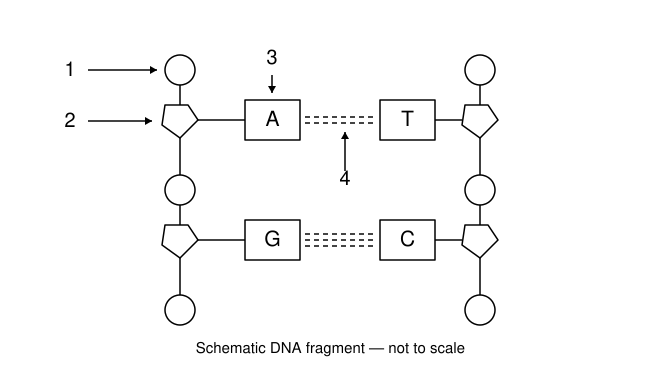
The diagram represents a short fragment of double-stranded DNA. Numbers 1–4 indicate structures or bonds.

Biology diagram for BIO26-ORIG-061

a) Identify structures 1, 2 and 3, and bond type 4. [4 marks]

b) Explain how complementary base pairing assists accurate DNA replication. [2 marks]

Question linkSyllabus coverage
Q62 · Practice questionComplex familiar5 marks

QUESTION 62 (5 marks)

One strand of a double-stranded DNA fragment is 5′-AAGTCCGA-3′.

a) Write its complementary strand, showing direction at both ends. [2 marks]

b) Determine the percentage of adenine bases in the entire double-stranded fragment. [2 marks]

c) Explain why the number of guanine bases must equal the number of cytosine bases in the entire fragment. [1 marks]

Question linkSyllabus coverage

All genetics and heredity practice questions

50 original questions · Page 1 of 3

  1. Q16 · Original practice · 1 mark
    In a double-stranded DNA molecule, 28% of the bases are adenine. What percentage are cytosine?
    Genetics and heredity
  2. Q17 · Original practice · 1 mark
    During DNA replication, which enzyme joins adjacent Okazaki fragments into a continuous strand?
    Genetics and heredity
  3. Q18 · Original practice · 1 mark
    A diploid animal has 12 chromosomes in its somatic cells. At metaphase I of meiosis, one cell contains
    Genetics and heredity
  4. Q19 · Original practice · 1 mark
    A DNA template is written 3′-TAC GGA CTT-5′3^\prime\text{-TAC GGA CTT-}5^\prime. The corresponding mRNA sequence, written 5′5^\prime to 3′3^\prime, is
    Genetics and heredity
  5. Q20 · Original practice · 1 mark
    A primary RNA transcript contains exon 1, intron 1, exon 2, intron 2 and exon 3, in that order. Which sequence remains after normal RNA splicing?
    Genetics and heredity
  6. Q21 · Original practice · 1 mark
    A coding sequence changes the mRNA codon UAU to UAA. Use the supplied genetic code excerpt. The mutation is
    Genetics and heredity
  7. Q22 · Original practice · 1 mark
    A woman with genotype XNXnX^NX^n and a man with genotype XNYX^NY have a child. The allele nn causes an X-linked recessive trait. Assuming equal probabilities of male and female offspring, the probability that their child has the trait is
    Genetics and heredity
  8. Q23 · Original practice · 1 mark
    For ABO blood groups, IAI^A and IBI^B are codominant and both dominate ii. A parent with genotype IAiI^Ai and a parent with genotype IBIBI^BI^B can produce children with blood groups
    Genetics and heredity
  9. Q24 · Original practice · 1 mark
    The histogram shows variation in a trait within a large population raised under similar conditions. Which pattern of inheritance is most consistent with the distribution?
    Genetics and heredity
  10. Q25 · Original practice · 1 mark
    A PCR starts with 3 double-stranded copies of a target region. Assuming ideal doubling in every cycle, how many double-stranded copies are present after 5 cycles?
    Genetics and heredity
  11. Q26 · Original practice · 1 mark
    The gel shows DNA fragments from an unknown sample U and three reference samples. Which reference has the same banding pattern as U?
    Genetics and heredity
  12. Q61 · Original practice · 6 marks
    The diagram represents a short fragment of double-stranded DNA. Numbers 1–4 indicate structures or bonds.
    Genetics and heredity
  13. Q62 · Original practice · 5 marks
    One strand of a double-stranded DNA fragment is 5′-AAGTCCGA-3′5^\prime\text{-AAGTCCGA-}3^\prime.
    Genetics and heredity
  14. Q63 · Original practice · 5 marks
    The replication fork moves to the right. Template-strand ends are labelled. Arrows on new DNA indicate synthesis direction.
    Genetics and heredity
  15. Q64 · Original practice · 6 marks
    A diploid species has 2n = 4. The diagram shows a cell before the first meiotic division (A) and one daughter cell after that division (B).
    Genetics and heredity
  16. Q65 · Original practice · 5 marks
    Two loci are linked on a homologous chromosome pair. The alleles are arranged ABAB on one homologue and abab on the other. A crossover occurs between the loci in two non-sister chromatids.
    Genetics and heredity
  17. Q66 · Original practice · 6 marks
    Letters represent chromosome segments, not individual nucleotides. Normal chromosomes have orders ABCDEF and PQRSTU. Four independent changes are shown.
    Genetics and heredity
  18. Q67 · Original practice · 7 marks
    The schematic karyotype shows a human cell. Chromosomes are arranged by numbered homologous groups. The sex chromosomes are labelled.
    Genetics and heredity
  19. Q68 · Original practice · 5 marks
    Compare spermatogenesis and oogenesis in humans.
    Genetics and heredity
  20. Q69 · Original practice · 6 marks
    A short coding region on a DNA template is 3′-TAC AAA GGC ACT-5′3^\prime\text{-TAC AAA GGC ACT-}5^\prime. The genetic code excerpt is provided.
    Genetics and heredity
  21. Q70 · Original practice · 6 marks
    A eukaryotic primary RNA transcript contains three exons of 90, 120 and 150 nucleotides, separated by two introns of 80 and 100 nucleotides. Ignore the 5′ cap and poly-A tail in length calculations.
    Genetics and heredity
  22. Q71 · Original practice · 5 marks
    An mRNA normally contains the codon GAA. Three independent base substitutions produce GAG, GUA and UAA. Use the code excerpt.
    Genetics and heredity
  23. Q72 · Original practice · 5 marks
    A translated mRNA segment begins 5′-AUG AAA GGC UCU UAA-3′5^\prime\text{-AUG AAA GGC UCU UAA-}3^\prime. Mutant P loses the fourth nucleotide; mutant Q loses nucleotides 4–6. Read from the original start codon.
    Genetics and heredity
  24. Q73 · Original practice · 5 marks
    Two cells from the same organism have the same DNA sequence. Measurements at one gene are shown. Chemical tags associated with compact chromatin are more abundant in cell A.
    Genetics and heredity