QUESTION 66 (6 marks)
Letters represent chromosome segments, not individual nucleotides. Normal chromosomes have orders ABCDEF and PQRSTU. Four independent changes are shown.
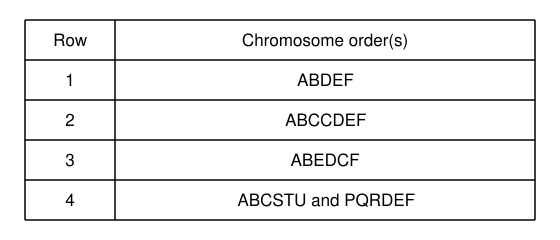
a) Identify the chromosome abnormality in each row. [4 marks]
b) Explain why a balanced reciprocal translocation need not change total DNA quantity, yet may still affect a phenotype. [2 marks]
Practice marking scheme
Answer
a) 1: deletion; 2: duplication; 3: inversion; 4: reciprocal translocation. b) Segments can be exchanged without net DNA loss, but a breakpoint can disrupt a gene or its regulation.
Working
Row 1 lacks C; row 2 repeats C; row 3 reverses CDE to EDC; row 4 exchanges DEF and STU between non-homologous chromosomes. A balanced exchange retains the overall amount of DNA, but joining sites can interrupt coding sequences or alter regulatory context, changing expression or protein function.
Marking criteria
- Identifies deletion. [1 mark]
- Identifies duplication. [1 mark]
- Identifies inversion. [1 mark]
- Identifies reciprocal translocation. [1 mark]
- Explains that an exchange can preserve overall DNA quantity. [1 mark]
- Identifies possible gene disruption or altered regulation at a breakpoint. [1 mark]
Practice question aligned to the current QCAA syllabus; review the worked solution and marking criteria.
View the QCAA syllabusCompare your working with the guide above.