QUESTION 64 (6 marks)
A diploid species has 2n = 4. The diagram shows a cell before the first meiotic division (A) and one daughter cell after that division (B).
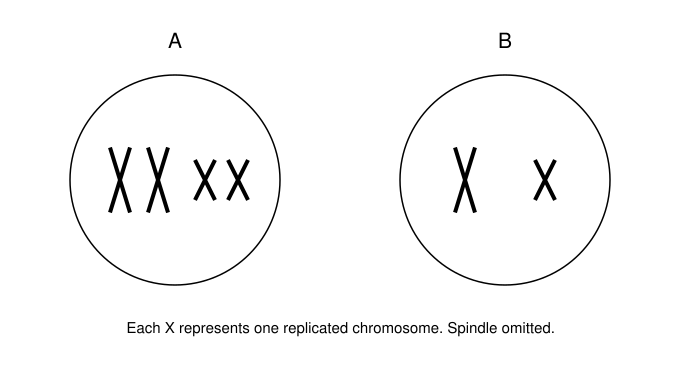
a) State the numbers of chromosomes and chromatids in each cell. [4 marks]
b) Explain why B is haploid even though its chromosomes still have two chromatids. [2 marks]
Practice marking scheme
Answer
a) A: 4 chromosomes, 8 chromatids; B: 2 chromosomes, 4 chromatids. b) Homologous chromosomes separated; B has one member of each homologous pair.
Working
Each X contains one centromere and two sister chromatids. Thus A has four chromosomes and eight chromatids; B has two chromosomes and four chromatids. Ploidy refers to the number of homologous chromosome sets, not the number of DNA copies within a replicated chromosome. Meiosis I separates homologues, leaving one set in each daughter cell.
Marking criteria
- States A has 4 chromosomes. [1 mark]
- States A has 8 chromatids. [1 mark]
- States B has 2 chromosomes. [1 mark]
- States B has 4 chromatids. [1 mark]
- Explains separation of homologous chromosomes in meiosis I. [1 mark]
- Explains that B contains one homologous set despite duplicated chromosomes. [1 mark]
Practice question aligned to the current QCAA syllabus; review the worked solution and marking criteria.
View the QCAA syllabusCompare your working with the guide above.