QUESTION 67 (7 marks)
The schematic karyotype shows a human cell. Chromosomes are arranged by numbered homologous groups. The sex chromosomes are labelled.
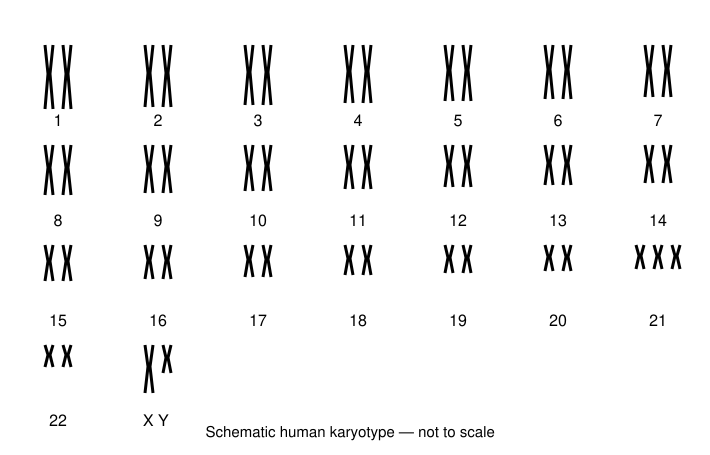
a) Identify the chromosome-number abnormality and the associated genetic condition. [2 marks]
b) State the total chromosome number and chromosomal sex. [2 marks]
c) Explain one meiotic error that could produce a gamete leading to this karyotype. [3 marks]
Practice marking scheme
Answer
a) Trisomy 21; Down syndrome. b) 47 chromosomes; XY male. c) Non-disjunction of chromosome 21 can produce a gamete with two copies; fertilisation by a normal gamete gives three.
Working
Group 21 contains three chromosomes rather than two. The cell therefore has 47 chromosomes, with X and Y sex chromosomes. Non-disjunction in meiosis I can keep both homologues in one daughter cell, or non-disjunction in meiosis II can keep sister chromatids together. An affected gamete with two chromosome-21 copies can combine with a normal gamete containing one copy.
Marking criteria
- Identifies trisomy 21. [1 mark]
- Names Down syndrome. [1 mark]
- States 47 chromosomes. [1 mark]
- Identifies XY male. [1 mark]
- Identifies non-disjunction in meiosis I or II. [1 mark]
- Describes a gamete receiving two copies of chromosome 21. [1 mark]
- Links fertilisation by a normal gamete to three copies in the zygote. [1 mark]
Practice question aligned to the current QCAA syllabus; review the worked solution and marking criteria.
View the QCAA syllabusCompare your working with the guide above.