QCEVault

Electric and magnetic fields practice

QCE Physics · Original practice questions with worked solutions

Practise field directions, charged-particle motion and forces on currents. Draw the field and charge/current direction before choosing a force rule.

Key ideas

  • For point charges, F=k∣q1q2∣/r2F=k|q_1q_2|/r^2. The force acts along the line joining the charges and is attractive for opposite signs.
  • Electric force is F=qE\mathbf F=q\mathbf E. A negative charge experiences force opposite to the electric field.
  • Magnetic-force magnitude is ∣q∣vBsin⁡θ|q|vB\sin\theta for a particle or BILsin⁡θBIL\sin\theta for a straight wire in a uniform field.

Worked example

A 2.0×10⁻⁶ C2.0\times10^{-6}\,\mathrm C charge in a 300 N C−1300\,\mathrm{N\,C^{-1}} field experiences a force of 6.0×10⁻⁴ N6.0\times10^{-4}\,\mathrm N.

A common mistake

A magnetic force changes the direction of a freely moving particle; it does no work on that particle because it is perpendicular to velocity.

Try these questions

Attempt each question before revealing the worked solution. Saved questions and checked answers also appear in the main bank on this device. Exam marks are recorded after marking a practice exam.

Q14 · Practice questionSimple familiar1 mark

QUESTION 14

Two point charges +2.0 μC+2.0\,\mu\text{C} and −3.0 μC-3.0\,\mu\text{C} are separated by 0.40 m0.40\,\text{m}. What is the magnitude and nature of the electrostatic force?
(A)
0.337 N0.337\,\text{N}, attractive
(B)
0.337 N0.337\,\text{N}, repulsive
(C)
3.37 N3.37\,\text{N}, attractive
(D)
3.37 N3.37\,\text{N}, repulsive
Question link
Q68 · Practice questionComplex unfamiliar6 marks

QUESTION 68 (6 marks)

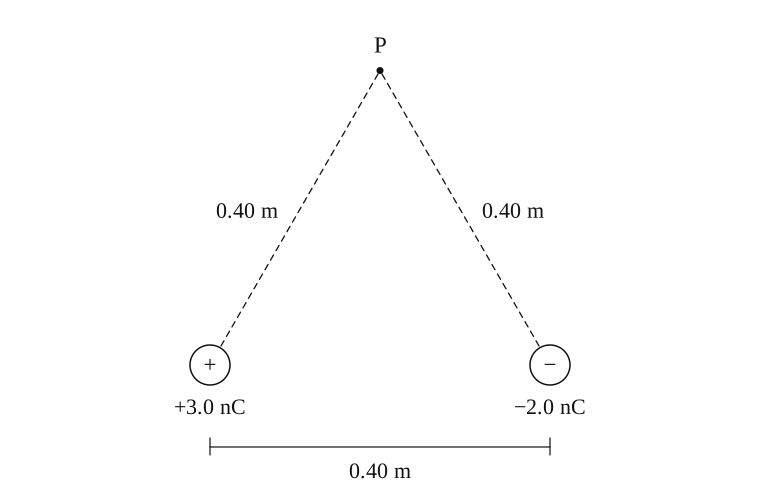
Two point charges +3.0 nC+3.0\,\text{nC} and −2.0 nC-2.0\,\text{nC} are separated by 0.40 m0.40\,\text{m}. Point P forms an equilateral triangle with the two charges, so P is 0.40 m0.40\,\text{m} from each charge. Determine the magnitude and direction of the net electric field at P.
Point P above two opposite point charges
Question link
Q69 · Practice questionComplex familiar4 marks

QUESTION 69 (4 marks)

Three charges lie on a straight line. A +4.0 μC+4.0\,\mu\text{C} charge is at x=0x=0, a +1.0 μC+1.0\,\mu\text{C} charge is at x=0.30 mx=0.30\,\text{m}, and a −2.0 μC-2.0\,\mu\text{C} charge is at x=0.80 mx=0.80\,\text{m}. Determine the net electrostatic force on the +1.0 μC+1.0\,\mu\text{C} charge.
Question link

All electric and magnetic fields practice questions
57 original questions · Page 1 of 3

  1. Q14 · Original practice · 1 mark
    Two point charges +2.0 μC+2.0\,\mu\text{C} and −3.0 μC-3.0\,\mu\text{C} are separated by 0.40 m0.40\,\text{m}. What is the magnitude and nature of the electrostatic force?
    Electrostatics
  2. Q15 · Original practice · 1 mark
    The diagram shows an electric field between two point charges. In which direction do the electric field lines point?
    Electrostatics
  3. Q16 · Original practice · 1 mark
    A +2.5 nC+2.5\,\text{nC} charge moves through a potential difference of +120 V+120\,\text{V}. What is its change in electrical potential energy?
    Electrostatics
  4. Q17 · Original practice · 1 mark
    A straight wire carries current out of the page, as shown. What is the direction of the magnetic field around the wire?
    Magnetic fields
  5. Q18 · Original practice · 1 mark
    A long solenoid has 750750 turns per metre and carries a current of 1.8 A1.8\,\text{A}. What magnetic flux density is produced inside it?
    Magnetic fields
  6. Q19 · Original practice · 1 mark
    An electron moves at 2.0×10⁶ m s−12.0\times10^6\,\text{m s}^{-1} perpendicular to a 0.20 T0.20\,\text{T} magnetic field. What is the magnitude of the magnetic force?
    Magnetic fields
  7. Q20 · Original practice · 1 mark
    A 0.28 m0.28\,\text{m} wire carrying 4.0 A4.0\,\text{A} makes an angle of 60∘60^\circ with a 0.35 T0.35\,\text{T} magnetic field. What force acts on the wire?
    Magnetic fields
  8. Q27 · Original practice · 1 mark
    The graph shows magnetic flux density measured at increasing distance from a small magnet. Which statement best describes the data?
    Magnetic fields
  9. Q68 · Original practice · 6 marks
    Two point charges +3.0 nC+3.0\,\text{nC} and −2.0 nC-2.0\,\text{nC} are separated by 0.40 m0.40\,\text{m}. Point P forms an equilateral triangle with the two charges, so P is 0.40 m0.40\,\text{m} from each charge. Determine the magnitude and direction of the net electric field at P.
    Electrostatics
  10. Q69 · Original practice · 4 marks
    Three charges lie on a straight line. A +4.0 μC+4.0\,\mu\text{C} charge is at x=0x=0, a +1.0 μC+1.0\,\mu\text{C} charge is at x=0.30 mx=0.30\,\text{m}, and a −2.0 μC-2.0\,\mu\text{C} charge is at x=0.80 mx=0.80\,\text{m}. Determine the net electrostatic force on the +1.0 μC+1.0\,\mu\text{C} charge.
    Electrostatics
  11. Q70 · Original practice · 4 marks
    A charge of −3.0 μC-3.0\,\mu\text{C} moves from a point at electric potential 250 V250\,\text{V} to a point at 40 V40\,\text{V}. Determine (a) the change in electric potential energy and (b) the work done by the electric field.
    Electrostatics
  12. Q71 · Original practice · 3 marks
    A 0.45 m0.45\,\text{m} straight wire carries 3.2 A3.2\,\text{A} to the right through a uniform 0.38 T0.38\,\text{T} magnetic field directed out of the page. Determine the magnitude and direction of the magnetic force on the wire.
    Magnetic fields
  13. Q72 · Original practice · 5 marks
    A proton enters a uniform 0.25 T0.25\,\text{T} magnetic field at 3.5×10⁶ m s−13.5\times10^6\,\text{m s}^{-1} perpendicular to the field. Show that the magnetic force can provide the centripetal force, then determine the radius of the proton’s circular path and its orbital period.
    Magnetic fields
  14. Q73 · Original practice · 3 marks
    A long solenoid has 12001200 turns per metre and carries a current of 2.50 A2.50\,\text{A}. Determine its internal magnetic flux density.
    Magnetic fields
  15. Q109 · Original practice · 1 mark
    At the midpoint between two equal positive point charges, the electric field is
    Electromagnetism
  16. Q110 · Original practice · 1 mark
    A straight wire carries conventional current north in a uniform magnetic field directed east. The magnetic force on the wire is
    Electromagnetism
  17. Q111 · Original practice · 1 mark
    A conducting loop is pulled out of aa region where a magnetic field is directed into the page. While the flux into the page is decreasing, the induced field is
    Electromagnetism
  18. Q112 · Original practice · 1 mark
    An ideal transformer has 600600 turns on its primary and 150150 turns on its secondary. A 240 Vrms240\,\mathrm{V} rms supply is connected to the primary. The secondary voltage is
    Electromagnetism
  19. Q113 · Original practice · 1 mark
    Which electromagnetic radiation has the greatest photon energy?
    Electromagnetism
  20. Q124 · Original practice · 1 mark
    A +3.0+3.0 microC charge moves through a potential difference of −20 V-20\,\mathrm{V}. Its change in electric potential energy is
    Electromagnetism
  21. Q127 · Original practice · 3 marks
    A 0.250 m0.250\,\mathrm{m} conductor carries 4.20A4.20 A horizontally west through a uniform 0.360 T0.360\,\mathrm{T} magnetic field directed vertically upward.
    Electromagnetism
  22. Q132 · Original practice · 5 marks
    A positive ion passes undeflected through crossed electric and magnetic fields. The electric field is 3.60×10⁴ N C−13.60\times10^{4}\,\mathrm{N}\,\mathrm{C}^{-1} upward and the magnetic field is 0.120 T0.120\,\mathrm{T} out of the page.
    Electromagnetism
  23. Q137 · Original practice · 5 marks
    A 250250-turn square coil of side 0.080 m0.080\,\mathrm{m} is initially perpendicular to a 0.300 T0.300\,\mathrm{T} magnetic field directed into the page. The field falls uniformly to 0.060 T0.060\,\mathrm{T} in 0.120 s0.120\,\mathrm{s}.
    Electromagnetism
  24. Q140 · Original practice · 1 mark
    A charged particle moves through a low-pressure gas in a region of uniform magnetic field directed into the page. Collisions with gas atoms cause the particle to lose kinetic energy, so its speed decreases along its path.
    The track of the particle between points P and Q is shown.
    Which row correctly identifies the sign of the charge on the particle and…
    Magnetic fields