QCE Physics · Original practice questions with worked solutions
Practise magnetic flux, induced emf, generators and transformers. Track how flux changes rather than assuming a field alone creates an emf.
Key ideas
Magnetic flux through a flat loop is Φ=BAcosθ, where θ is measured from the area normal.
Faraday’s law gives E=−NdΦ/dt. For a finite interval, use the average rate of flux change.
Lenz’s law gives an induced effect that opposes the change in flux. Use it to establish direction separately from magnitude.
Worked example
For 100 turns and a flux change of 2.0×10⁻⁴Wb in 0.050s, the average emf magnitude is 0.40V.
A common mistake
The flux angle is measured from the normal to the loop, not from the plane of the loop.
Try these questions
Attempt each question before revealing the worked solution. Saved questions and checked answers also appear in the main bank on this device. Exam marks are recorded after marking a practice exam.
Q21 · Practice questionComplex familiar1 mark
QUESTION 21
A uniform magnetic field of 0.50T passes through a loop of area 0.030m2. The field is at 60∘ to the loop normal. What is the magnetic flux?
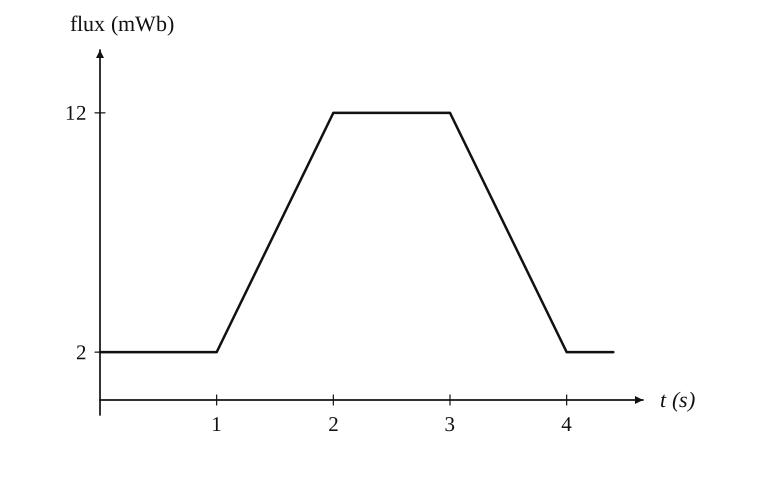
The magnetic flux through each turn of a 50-turn coil varies with time as shown. From t=1.0 to 2.0s, the flux rises linearly from 2.0mWb to 12.0mWb; it is constant from 2.0 to 3.0s and falls back to 2.0mWb from 3.0 to 4.0s. Determine the induced EMF in each of these three intervals, including the relative polarity.
1–2s: 0.50V; 2–3s: 0; 3–4s: 0.50V with opposite polarity to the first interval.
Use E=−NΔΦ/Δt.
From 1–2 s,
∣E∣=501.0(12.0−2.0)×10−3=0.50V.
From 2–3 s, ΔΦ=0, so E=0.
From 3–4 s, the flux change has the same magnitude but opposite sign, so the induced EMF has magnitude 0.50V and opposite polarity.
Uses Faraday’s law.
[1 mark]
Calculates first interval EMF.
[1 mark]
Identifies zero EMF on plateau.
[1 mark]
Calculates final interval magnitude.
[1 mark]
Identifies opposite polarity.
[1 mark]
Q75 · Practice questionComplex familiar4 marks
QUESTION 75 (4 marks)
A conducting rod moves to the right through a uniform magnetic field directed into the page. Explain why a potential difference develops between the rod’s ends and identify which end becomes positive.
The magnetic force separates charges; for a rod moving right with B into the page, positive charge is driven upward, so the upper end becomes positive.
Charges in the moving conductor experience magnetic force F=qv×B. For positive charge, v is right and B is into the page, so v×B is upward. Electrons experience the opposite force and accumulate at the lower end. Charge separation creates an internal electric field and hence a potential difference. The upper end is positive relative to the lower end.
Links moving charges to magnetic force.
[1 mark]
Uses correct force direction for positive charge.
[1 mark]
Explains charge separation and potential difference.