QCE Vault / Physics Gravity, orbits and circular motion practice QCE Physics · Original practice questions with worked solutions
Browse all questions Projectile motion practice Quantum theory practice Gravity, orbits and circular motion practice Electric and magnetic fields practice Electromagnetic induction practice Special relativity practice The Standard Model practice Original practice exam Practise force resolution, inclined planes, gravitation and orbital motion. Identify which forces produce the acceleration and measure orbital radius from the centre.
Key ideas For a circular path, a c = v 2 / r a_c=v^2/r a c = v 2 / r and the net inward force is m v 2 / r mv^2/r m v 2 / r . Centripetal force is the resulting inward force, not an extra force. Newton’s gravitational law gives F = G M m / r 2 F=GMm/r^2 F = GM m / r 2 , with r r r measured between the centres of the masses. For a circular orbit around a dominant mass M M M , v = G M / r v=\sqrt{GM/r} v = GM / r and T 2 = 4 π 2 r 3 / ( G M ) T^2=4\pi^2r^3/(GM) T 2 = 4 π 2 r 3 / ( GM ) . Worked example For constant orbital speed, velocity still changes direction, so the satellite has inward acceleration v 2 / r v^2/r v 2 / r . A common mistake For an orbital height above a planet, add the planet’s radius before using a centre-to-centre formula.
Try these questions Attempt each question before revealing the worked solution. Saved questions and checked answers also appear in the main bank on this device. Exam marks are recorded after marking a practice exam.
Q4 · Practice question Simple familiar 1 mark
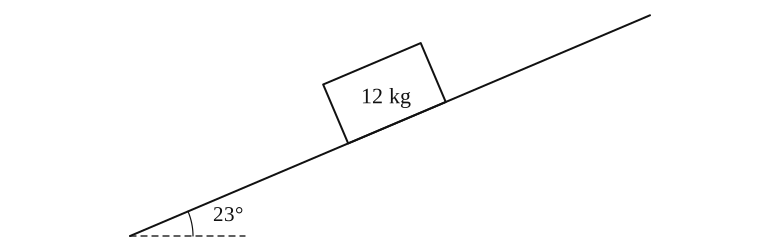
QUESTION 4 A 12.0 kg 12.0\,\text{kg} 12.0 kg block rests on a frictionless plane inclined at 23 ∘ 23^\circ 2 3 ∘ to the horizontal, as shown. What is the magnitude of the normal force? (A) 46.0 N 46.0\,\text{N} 46.0 N N = m g cos 23 ∘ = ( 12.0 ) ( 9.8 ) cos 23 ∘ = 108 N N=mg\cos23^\circ=(12.0)(9.8)\cos23^\circ=108\,\text{N} N = m g cos 2 3 ∘ = ( 12.0 ) ( 9.8 ) cos 2 3 ∘ = 108 N . Select the correct option.
[1 mark] Q60 · Practice question Simple familiar 3 marks
QUESTION 60 (3 marks) A 9.0 kg 9.0\,\text{kg} 9.0 kg block slides down a 28 ∘ 28^\circ 2 8 ∘ incline. A constant friction force of 18 N 18\,\text{N} 18 N acts up the slope. Determine the block’s acceleration. ANSWER a = 2.60 m s − 2 a=2.60\,\text{m s}^{-2} a = 2.60 m s − 2 down the slope. The downslope component of weight is
m g sin 28 ∘ = ( 9.0 ) ( 9.8 ) sin 28 ∘ = 41.4 N . mg\sin28^\circ=(9.0)(9.8)\sin28^\circ=41.4\,\text{N}. m g sin 2 8 ∘ = ( 9.0 ) ( 9.8 ) sin 2 8 ∘ = 41.4 N .
The net force is
F n e t = 41.4 − 18 = 23.4 N . F_{net}=41.4-18=23.4\,\text{N}. F n e t = 41.4 − 18 = 23.4 N .
Thus
a = F n e t / m = 23.4 / 9.0 = 2.60 m s − 2 a=F_{net}/m=23.4/9.0=2.60\,\text{m s}^{-2} a = F n e t / m = 23.4/9.0 = 2.60 m s − 2
down the slope. Finds the component of weight down the slope.
[1 mark] Calculates acceleration with direction.
[1 mark] Q61 · Practice question Complex familiar 4 marks
QUESTION 61 (4 marks) A 20.0 kg 20.0\,\text{kg} 20.0 kg crate is pulled up a frictionless 15 ∘ 15^\circ 1 5 ∘ incline by a rope parallel to the slope with tension 140 N 140\,\text{N} 140 N . Determine the acceleration of the crate. ANSWER a = 4.47 m s − 2 a=4.47\,\text{m s}^{-2} a = 4.47 m s − 2 up the slope. The component of weight down the slope is
m g sin 15 ∘ = ( 20.0 ) ( 9.8 ) sin 15 ∘ = 50.7 N . mg\sin15^\circ=(20.0)(9.8)\sin15^\circ=50.7\,\text{N}. m g sin 1 5 ∘ = ( 20.0 ) ( 9.8 ) sin 1 5 ∘ = 50.7 N .
Taking up the slope as positive,
F n e t = 140 − 50.7 = 89.3 N . F_{net}=140-50.7=89.3\,\text{N}. F n e t = 140 − 50.7 = 89.3 N .
Then
a = 89.3 / 20.0 = 4.47 m s − 2 . a=89.3/20.0=4.47\,\text{m s}^{-2}. a = 89.3/20.0 = 4.47 m s − 2 . Resolves weight parallel to slope.
[1 mark] Forms correct net-force expression.
[1 mark] Applies Newton’s second law.
[1 mark] States correct magnitude and direction.
[1 mark] All gravity, orbits and circular motion practice questions 62 original questions · Page 1 of 3
Q4 · Original practice · 1 mark A 12.0 kg 12.0\,\text{kg} 12.0 kg block rests on a frictionless plane inclined at 23 ∘ 23^\circ 2 3 ∘ to the horizontal, as shown. What is the magnitude of the normal force? Inclined planes and circular motion Q5 · Original practice · 1 mark A marker on a rotating platform moves in a circle of radius 0.85 m 0.85\,\text{m} 0.85 m with period 1.60 s 1.60\,\text{s} 1.60 s . What is its speed? Inclined planes and circular motion Q6 · Original practice · 1 mark A 0.45 kg 0.45\,\text{kg} 0.45 kg object moves at 4.2 m s − 1 4.2\,\text{m s}^{-1} 4.2 m s − 1 in a horizontal circle of radius 0.75 m 0.75\,\text{m} 0.75 m . What net inward force is required? Inclined planes and circular motion Q7 · Original practice · 1 mark Two masses of 5.0 × 10 24 kg 5.0\times10^{24}\,\text{kg} 5.0 × 1 0 24 kg and 800 kg 800\,\text{kg} 800 kg are separated by 7.0 × 10 6 m 7.0\times10^6\,\text{m} 7.0 × 1 0 6 m between their centres. What is the gravitational force between them? Orbital mechanics Q8 · Original practice · 1 mark The gravitational field strength at the surface of a spherical planet is 9.8 N kg − 1 9.8\,\text{N kg}^{-1} 9.8 N kg − 1 . At a distance of 2 R 2R 2 R from the planet centre, where R R R is the planet radius, the field strength is approximately Orbital mechanics Q9 · Original practice · 1 mark Satellite B orbits the same planet at four times the orbital radius of satellite A. What is T B / T A T_B/T_A T B / T A ? Orbital mechanics Q10 · Original practice · 1 mark A satellite is in a circular orbit of radius 8.0 × 10 6 m 8.0\times10^6\,\text{m} 8.0 × 1 0 6 m around a planet of mass 6.0 × 10 24 kg 6.0\times10^{24}\,\text{kg} 6.0 × 1 0 24 kg . Its orbital speed is closest to Orbital mechanics Q12 · Original practice · 1 mark A block is sliding down a rough inclined plane. Which force acts parallel to the plane and up the slope?
Inclined planes and circular motion Q13 · Original practice · 1 mark For several moons orbiting the same planet, which quantity should be approximately constant?
Orbital mechanics Q60 · Original practice · 3 marks A 9.0 kg 9.0\,\text{kg} 9.0 kg block slides down a 28 ∘ 28^\circ 2 8 ∘ incline. A constant friction force of 18 N 18\,\text{N} 18 N acts up the slope. Determine the block’s acceleration. Inclined planes and circular motion Q61 · Original practice · 4 marks A 20.0 kg 20.0\,\text{kg} 20.0 kg crate is pulled up a frictionless 15 ∘ 15^\circ 1 5 ∘ incline by a rope parallel to the slope with tension 140 N 140\,\text{N} 140 N . Determine the acceleration of the crate. Inclined planes and circular motion Q62 · Original practice · 3 marks A 1100 kg 1100\,\text{kg} 1100 kg car travels at constant speed 14.0 m s − 1 14.0\,\text{m s}^{-1} 14.0 m s − 1 around a level circular curve of radius 42.0 m 42.0\,\text{m} 42.0 m . Determine the centripetal acceleration and the net horizontal force. Inclined planes and circular motion Q63 · Original practice · 4 marks The graph shows gravitational field strength outside a spherical body. The body surface is at radius R R R . If the field strength at R R R is 12.0 N kg − 1 12.0\,\text{N kg}^{-1} 12.0 N kg − 1 , determine the field strength at 1.5 R 1.5R 1.5 R and explain the shape of the curve. Orbital mechanics Q64 · Original practice · 4 marks A satellite orbits Earth in a circular orbit of radius 7.00 × 10 6 m 7.00\times10^6\,\text{m} 7.00 × 1 0 6 m . Take Earth’s mass as 5.97 × 10 24 kg 5.97\times10^{24}\,\text{kg} 5.97 × 1 0 24 kg . Determine the orbital period in minutes. Orbital mechanics Q65 · Original practice · 3 marks Two satellites orbit the same planet. Satellite B has an orbital radius 1.50 1.50 1.50 times that of satellite A. Determine T B / T A T_B/T_A T B / T A . Orbital mechanics Q66 · Original practice · 5 marks A moon completes a circular orbit of radius 9.0 × 10 6 m 9.0\times10^6\,\text{m} 9.0 × 1 0 6 m around an unknown planet in 2.00 h 2.00\,\text{h} 2.00 h . Determine the mass of the planet. Orbital mechanics Q67 · Original practice · 6 marks A spherical exoplanet has radius 4.0 × 10 6 m 4.0\times10^6\,\text{m} 4.0 × 1 0 6 m and surface gravitational field strength 15.0 N kg − 1 15.0\,\text{N kg}^{-1} 15.0 N kg − 1 . A small satellite is placed in a circular orbit at radius 8.0 × 10 6 m 8.0\times10^6\,\text{m} 8.0 × 1 0 6 m from the planet centre. Determine (a) the planet mass and (b) the satellite orbital period. Orbital mechanics Q103 · Original practice · 6 marks Five satellites move in approximately circular orbits around the same planet. Their measured orbital radii and periods were processed to produce the graph. The broken line shows a proportional T 2 T^2 T 2 -versus- r 3 r^3 r 3 model fitted to the data, consistent with Kepler's third law. Orbital mechanics Q106 · Original practice · 1 mark A cyclist rounds a level circular bend at constant speed. Which vector points towards the centre of the bend?
Gravity and motion Q107 · Original practice · 1 mark A satellite is moved from a circular orbit of radius r r r to a circular orbit of radius 4 r 4r 4 r around the same planet. Its orbital speed becomes Gravity and motion Q108 · Original practice · 1 mark Two projectiles are launched from level ground with the same speed at 25 ∘ 25^{\circ} 2 5 ∘ and 65 ∘ 65^{\circ} 6 5 ∘ . Neglect air resistance. Which quantity is the same for both? Gravity and motion Q125 · Original practice · 1 mark Planet B orbits the same star at 9 9 9 times Planet A’s orbital radius. The ratio T B T A \frac{T_B}{T_A} T A T B is Gravity and motion Q126 · Original practice · 3 marks A rescue capsule is launched from a 3.0 m 3.0\,\mathrm{m} 3.0 m high platform at 24.0 m s − 1 24.0\,\mathrm{m}\,\mathrm{s}^{-1} 24.0 m s − 1 and 40.0 ∘ 40.0^{\circ} 40. 0 ∘ above the horizontal. Air resistance is negligible. Gravity and motion Q131 · Original practice · 5 marks A drone moves with horizontal velocity components 6.0 m s − 1 6.0\,\mathrm{m}\,\mathrm{s}^{-1} 6.0 m s − 1 east and 8.0 m s − 1 8.0\,\mathrm{m}\,\mathrm{s}^{-1} 8.0 m s − 1 north before releasing a package from a height of 45 m 45\,\mathrm{m} 45 m . Neglect air resistance. Gravity and motion