Q103 · Practice questionComplex familiar6 marks
QUESTION 103 (6 marks)
Five satellites move in approximately circular orbits around the same planet. Their measured orbital radii and periods were processed to produce the graph. The broken line shows a proportional -versus- model fitted to the data, consistent with Kepler's third law.
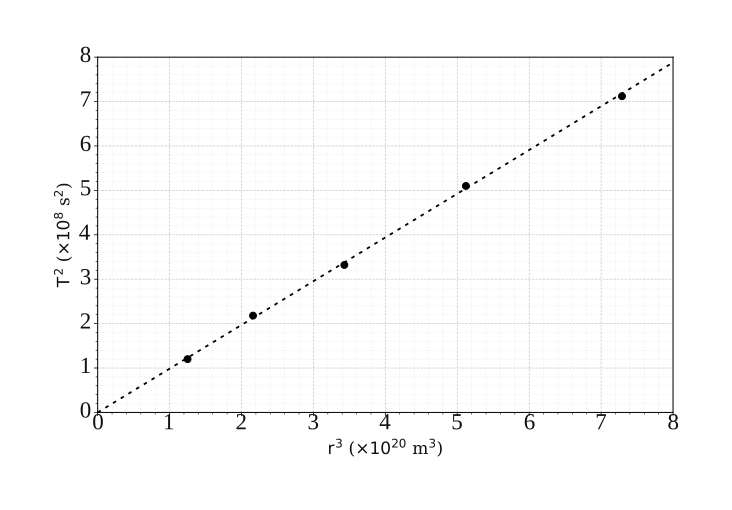
a)[4 marks]
Use the graph and Kepler's third law to determine the mass of the planet. Show your working.
b)[2 marks]
A sixth satellite has an orbital radius of . Predict its orbital period.
WORKED SOLUTION
6 marksPractice marking scheme
ANSWER
(a) ; (b) (about )
Worked solution
a) Planet mass
Answer: approximately .
Reading the proportional model line gives a scaled gradient of about
Because the vertical axis is and the horizontal axis is , the physical gradient is
Kepler's third law gives
Thus
Tolerance: a scaled gradient from about to is reasonable when read from the supplied graph. This corresponds to approximately . A consistent answer within this interval should receive the numerical-answer mark.
b) Sixth satellite
Answer: , or about .
Using ,
Tolerance / follow-through: for accepted graph gradients above, approximately is reasonable. Follow-through should be allowed from a consistent gradient or mass from part (a).
Alternative approach: use the planet mass from part (a) directly in .
Key insight: plotting against turns Kepler's third law into a straight-line relationship whose gradient contains the planet's mass.
determines the scaled gradient from the line.
converts the axis scale factors correctly to obtain the physical gradient.
relates the gradient to and rearranges for .
obtains a mass consistent with the graph, with units.
applies the relationship from part (a), or Kepler's third law with the mass found in part (a).
obtains a period consistent with the graph/part (a), with units.
Practice question aligned to the current QCAA syllabus; review the worked solution and marking criteria.
View the QCAA syllabusHow many marks did you earn?
Compare your working with the guide above.