QCE Vault / Physics Quantum theory practice QCE Physics · Original practice questions with worked solutions
Browse all questions Projectile motion practice Quantum theory practice Original practice exam Practise photon energy, the photoelectric effect and wave–particle relationships. Identify whether a question is asking about energy per photon, the number of photons or the kinetic energy of emitted electrons.
Key ideas Photon energy is E = h f = h c / λ E=hf=hc/\lambda E = h f = h c / λ . Convert wavelength to metres before substituting SI values. For the photoelectric effect, K max = h f − ϕ K_{\max}=hf-\phi K m a x = h f − ϕ when photon energy meets the work function. The threshold frequency is f 0 = ϕ / h f_0=\phi/h f 0 = ϕ / h . For a particle with momentum p p p , the de Broglie wavelength is λ = h / p \lambda=h/p λ = h / p . Worked example If a photon has energy 5.0 e V 5.0\,\mathrm{eV} 5.0 eV and a metal has work function 2.0 e V 2.0\,\mathrm{eV} 2.0 eV , the maximum emitted-electron kinetic energy is 3.0 e V 3.0\,\mathrm{eV} 3.0 eV . A common mistake Increasing light intensity at a fixed frequency increases the photon arrival rate, not the energy of each photon.
Try these questions Attempt each question before revealing the worked solution. Saved questions and marks also appear in the main bank on this device.
Q38 · Practice question Simple familiar 1 mark
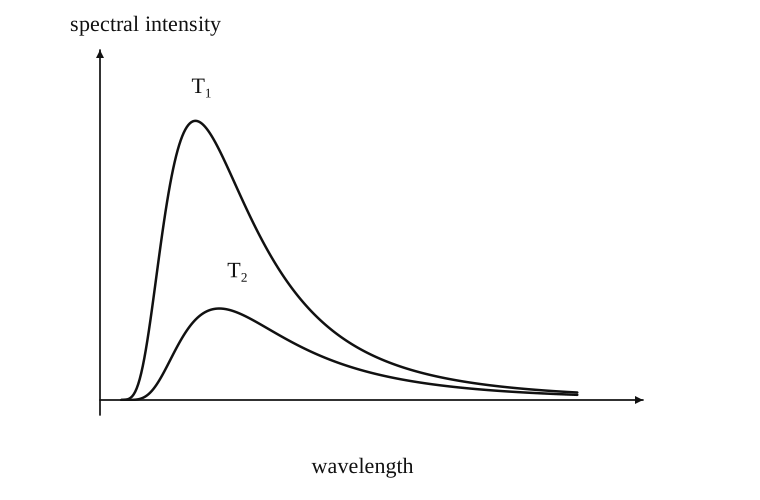
QUESTION 38 Two idealised blackbody curves are shown. Curve T 1 T_1 T 1 has a shorter peak wavelength than curve T 2 T_2 T 2 . Which statement is correct? (D) Temperature cannot be inferred from peak wavelength.
WORKED SOLUTION
Answer C 1 mark Worked solution
Wien’s law gives λ m a x = b / T \lambda_{max}=b/T λ ma x = b / T . A shorter peak wavelength corresponds to a higher temperature. Select the correct option.
[1 mark] Practice question aligned to the current QCAA syllabus; review the worked solution and marking criteria.
View the QCAA syllabus Q88 · Practice question Simple familiar 3 marks
QUESTION 88 (3 marks) A star has a blackbody peak wavelength of 620 nm 620\,\text{nm} 620 nm . Estimate its surface temperature using Wien’s law. WORKED SOLUTION
Practice marking scheme 3 marks ANSWER T = 4.67 × 10 3 K T=4.67\times10^3\,\text{K} T = 4.67 × 1 0 3 K . Worked solution
T = b λ m a x = 2.898 × 10 − 3 620 × 10 − 9 = 4.67 × 10 3 K . T=\frac{b}{\lambda_{max}}=\frac{2.898\times10^{-3}}{620\times10^{-9}}=4.67\times10^3\,\text{K}. T = λ ma x b = 620 × 1 0 − 9 2.898 × 1 0 − 3 = 4.67 × 1 0 3 K . Converts wavelength correctly.
[1 mark] Practice question aligned to the current QCAA syllabus; review the worked solution and marking criteria.
View the QCAA syllabus How many marks did you earn? Compare your working with the guide above.
Q89 · Practice question Complex familiar 5 marks
QUESTION 89 (5 marks) Light of frequency 9.0 × 10 14 Hz 9.0\times10^{14}\,\text{Hz} 9.0 × 1 0 14 Hz illuminates a metal of work function 2.30 eV 2.30\,\text{eV} 2.30 eV . Determine the maximum kinetic energy of emitted photoelectrons in eV and the corresponding maximum electron speed. WORKED SOLUTION
Practice marking scheme 5 marks ANSWER E k , m a x = 1.42 eV E_{k,max}=1.42\,\text{eV} E k , ma x = 1.42 eV ; v m a x = 7.07 × 10 5 m s − 1 v_{max}=7.07\times10^5\,\text{m s}^{-1} v ma x = 7.07 × 1 0 5 m s − 1 . Worked solution
Photon energy:
E = h f = ( 6.626 × 10 − 34 ) ( 9.0 × 10 14 ) = 5.96 × 10 − 19 J = 3.72 eV . E=hf=(6.626\times10^{-34})(9.0\times10^{14})=5.96\times10^{-19}\,\text{J}=3.72\,\text{eV}. E = h f = ( 6.626 × 1 0 − 34 ) ( 9.0 × 1 0 14 ) = 5.96 × 1 0 − 19 J = 3.72 eV .
Hence
E k = 3.72 − 2.30 = 1.42 eV . E_k=3.72-2.30=1.42\,\text{eV}. E k = 3.72 − 2.30 = 1.42 eV .
In joules, E k = ( 1.42 ) ( 1.602 × 10 − 19 ) = 2.28 × 10 − 19 J E_k=(1.42)(1.602\times10^{-19})=2.28\times10^{-19}\,\text{J} E k = ( 1.42 ) ( 1.602 × 1 0 − 19 ) = 2.28 × 1 0 − 19 J .
Using E k = 1 2 m e v 2 E_k=\tfrac12m_ev^2 E k = 2 1 m e v 2 ,
v = 2 E k m e = 2 ( 2.28 × 10 − 19 ) 9.11 × 10 − 31 = 7.07 × 10 5 m s − 1 . v=\sqrt{\frac{2E_k}{m_e}}=\sqrt{\frac{2(2.28\times10^{-19})}{9.11\times10^{-31}}}=7.07\times10^5\,\text{m s}^{-1}. v = m e 2 E k = 9.11 × 1 0 − 31 2 ( 2.28 × 1 0 − 19 ) = 7.07 × 1 0 5 m s − 1 . Calculates photon energy.
[1 mark] Converts kinetic energy to joules.
[1 mark] Uses kinetic-energy relationship.
[1 mark] Calculates electron speed.
[1 mark] Practice question aligned to the current QCAA syllabus; review the worked solution and marking criteria.
View the QCAA syllabus How many marks did you earn? Compare your working with the guide above.
All quantum theory practice questions 56 original questions · Page 1 of 3
Q38 · Original practice · 1 mark Two idealised blackbody curves are shown. Curve T 1 T_1 T 1 has a shorter peak wavelength than curve T 2 T_2 T 2 . Which statement is correct? Quantum theory Q39 · Original practice · 1 mark What is the energy of a photon of wavelength 500 nm 500\,\text{nm} 500 nm ? Quantum theory Q40 · Original practice · 1 mark Photons of energy 6.0 eV 6.0\,\text{eV} 6.0 eV strike a metal with work function 2.2 eV 2.2\,\text{eV} 2.2 eV . The maximum photoelectron kinetic energy is Quantum theory Q41 · Original practice · 1 mark A metal has work function 2.50 eV 2.50\,\text{eV} 2.50 eV . Its threshold frequency is closest to Quantum theory Q42 · Original practice · 1 mark For a graph of maximum photoelectron kinetic energy against incident frequency, the gradient is equal to
Quantum theory Q43 · Original practice · 1 mark Monochromatic light passes through two narrow slits and a detector screen records alternating bright and dark bands. Which feature of light is most directly demonstrated by this observation?
Quantum theory Q44 · Original practice · 1 mark The diagram shows atomic energy levels and a downward transition X X X . During transition X X X , the atom Quantum theory Q45 · Original practice · 1 mark For hydrogen, the wavelength emitted in the n i = 3 n_i=3 n i = 3 to n f = 2 n_f=2 n f = 2 transition is closest to Quantum theory Q46 · Original practice · 1 mark An electron travels at 2.0 × 10 6 m s − 1 2.0\times10^6\,\text{m s}^{-1} 2.0 × 1 0 6 m s − 1 . Its de Broglie wavelength is closest to Quantum theory Q47 · Original practice · 1 mark Which pair gives evidence for both wave and particle behaviour of light?
Quantum theory Q88 · Original practice · 3 marks A star has a blackbody peak wavelength of 620 nm 620\,\text{nm} 620 nm . Estimate its surface temperature using Wien’s law. Quantum theory Q89 · Original practice · 5 marks Light of frequency 9.0 × 10 14 Hz 9.0\times10^{14}\,\text{Hz} 9.0 × 1 0 14 Hz illuminates a metal of work function 2.30 eV 2.30\,\text{eV} 2.30 eV . Determine the maximum kinetic energy of emitted photoelectrons in eV and the corresponding maximum electron speed. Quantum theory Q90 · Original practice · 6 marks Photoelectric data for a metal are shown below.
frequency ( 10 14 10^{14} 1 0 14 Hz) 7.0 8.0 9.0 maximum kinetic energy (eV) 0.40 0.81 1.23
Use the data to estimate (a) Planck’s constant in eV s \text{eV s} eV s , (b) the threshold frequency and (c) the work function. Quantum theory Q91 · Original practice · 5 marks The hydrogen energy levels n = 1 n=1 n = 1 to n = 4 n=4 n = 4 are shown. Of all possible downward transitions starting from n = 4 n=4 n = 4 , identify the transition that produces the longest-wavelength photon and calculate that wavelength using the energy values on the diagram. Quantum theory Q92 · Original practice · 4 marks Use the Rydberg equation to determine the wavelength emitted when a hydrogen electron falls from n = 4 n=4 n = 4 to n = 2 n=2 n = 2 . Quantum theory Q93 · Original practice · 3 marks A proton moves at 4.0 × 10 5 m s − 1 4.0\times10^5\,\text{m s}^{-1} 4.0 × 1 0 5 m s − 1 . Determine its de Broglie wavelength. Quantum theory Q94 · Original practice · 5 marks Contrast Rutherford’s and Bohr’s atomic models, and explain why Bohr’s model can account for discrete hydrogen emission lines whereas Rutherford’s model cannot.
Quantum theory Q95 · Original practice · 6 marks A star can be approximated as a blackbody with peak wavelength 480 nm 480\,\text{nm} 480 nm . A metal surface has work function 2.70 eV 2.70\,\text{eV} 2.70 eV . Determine (a) the star’s approximate surface temperature, (b) the energy in eV of a photon at the peak wavelength and (c) whether a peak-wavelength photon can eject an electron from the metal. Quantum theory Q105 · Original practice · 8 marks An electron enters a uniform magnetic field B = 2.00 × 10 − 3 T B=2.00\times10^{-3}\,\mathrm{T} B = 2.00 × 1 0 − 3 T directed into the page, with velocity perpendicular to the field. The measured circular-path radius is 2.50 × 10 − 2 m 2.50\times10^{-2}\,\mathrm{m} 2.50 × 1 0 − 2 m . The speed is low enough that classical momentum p = m v p=mv p = m v may be used. Quantum theory Q116 · Original practice · 1 mark Increasing the intensity of light below a metal’s threshold frequency will
Quantum theory Q117 · Original practice · 1 mark If a particle’s momentum triples, its de Broglie wavelength becomes
Quantum theory Q118 · Original practice · 1 mark An electron in hydrogen drops from n = 4 n=4 n = 4 to n = 2 n=2 n = 2 . Compared with a drop from n = 3 n=3 n = 3 to n = 2 n=2 n = 2 , the emitted photon has Quantum theory Q119 · Original practice · 1 mark A black-body spectrum shifts to a smaller peak wavelength when temperature increases. This is described by
Quantum theory Q129 · Original practice · 9 marks A photoelectric experiment gives the following stopping potentials: f 10 14 H z = 5.5 , 6.5 , 7.5 , 8.5 \frac{f}{10^{14} Hz} = 5.5, 6.5, 7.5, 8.5 1 0 14 H z f = 5.5 , 6.5 , 7.5 , 8.5 and V s V = 0.18 , 0.59 , 1.01 , 1.43 \frac{V_s}{V} = 0.18, 0.59, 1.01, 1.43 V V s = 0.18 , 0.59 , 1.01 , 1.43 . Treat the trend as linear. Quantum theory