Q129 · Practice questionComplex unfamiliar9 marks
QUESTION 129 (9 marks)
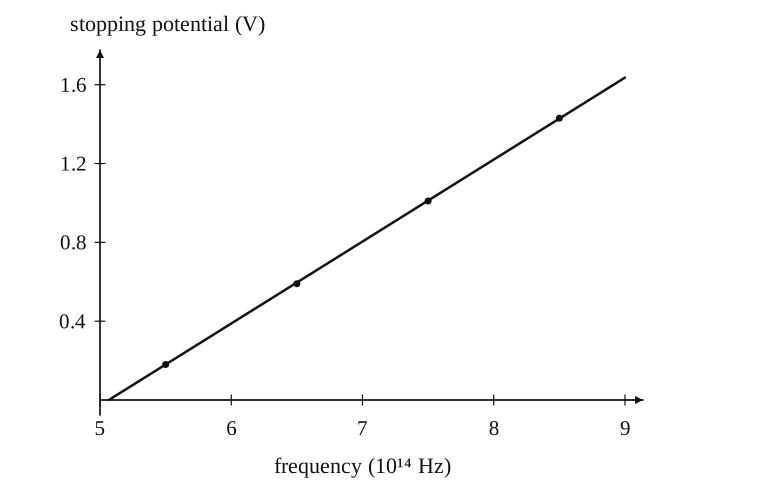
A photoelectric experiment gives the following stopping potentials: and . Treat the trend as linear.
a)[3 marks]
Determine the and use it to estimate Planck’s constant.
b)[3 marks]
Estimate the threshold frequency and work function.
c)[3 marks]
Explain how the data support the photon model and identify one experimental limitation.
WORKED SOLUTION
9 marksPractice marking scheme
ANSWER
The approximately linear – relation and non-zero threshold agree with , showing energy is delivered in photons. A limitation could be contact-potential uncertainty, surface contamination, finite meter resolution or scatter in stopping-potential determination.
Worked solution
Part (a): Using endpoints, . Since .
Part (b): Using : . Threshold . Work function .
Part (c): The approximately linear – relation and non-zero threshold agree with , showing energy is delivered in photons. A limitation could be contact-potential uncertainty, surface contamination, finite meter resolution or scatter in stopping-potential determination.
Part (a): completes the requested reasoning and obtains a correct result.
Part (b): completes the requested reasoning and obtains a correct result.
Part (c): completes the requested reasoning and obtains a correct result.
Practice question aligned to the current QCAA syllabus; review the worked solution and marking criteria.
View the QCAA syllabusHow many marks did you earn?
Compare your working with the guide above.