QCEVault

Quantum theory — Question 15

QCAA 2025, Paper 1 · 1 mark

Q15 · 2025 · Paper 1Complex familiar1 mark

QUESTION 15

Questions 15–16 refer to the following scenario. Researchers conducted a photoelectric effect experiment in which light was shone on two unknown metals, R and X. The results were analysed to produce the graph shown.
The graph for metal X has a theoretical gradient equivalent to
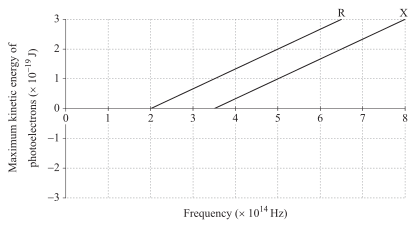
Official QCAA graph of maximum photoelectron kinetic energy against frequency for metals R and X.
(A)
6.6 × 10⁻³⁴ J s
(B)
1.3 × 10⁻¹⁹ J
(C)
6.7 × 10⁻¹ J Hz−1
(D)
2.0 × 10¹⁴ Hz
Question linkOriginal paper

Related questions

  1. Q7 · 2025 QCAA · Paper 1 · 1 mark
    What key feature differentiates the Bohr model of the atom from the Rutherford model?
    Quantum theory
  2. Q16 · 2025 QCAA · Paper 1 · 1 mark
    Questions 15–16 refer to the following scenario. Researchers conducted a photoelectric effect experiment in which light was shone on two unknown metals, R and X. The results were analysed to produce the graph shown.
    The work function for metal R is
    Quantum theory
  3. Q20 · 2025 QCAA · Paper 1 · 1 mark
    When a black body is heated, a graph with a distinctive peak is produced, as shown.
    This black body curve can be used to demonstrate that
    Quantum theory
  4. Q24 · 2025 QCAA · Paper 1 · 9 marks
    A monochromatic light source was shone on a metal surface and photoelectrons were ejected. A different light source of lower frequency was then shone on the same metal surface. No photoelectrons were ejected, even when the intensity of the light was increased.
    Quantum theory