Q105 · Practice questionComplex unfamiliar8 marks
QUESTION 105 (8 marks)
An electron enters a uniform magnetic field directed into the page, with velocity perpendicular to the field. The measured circular-path radius is . The speed is low enough that classical momentum may be used.
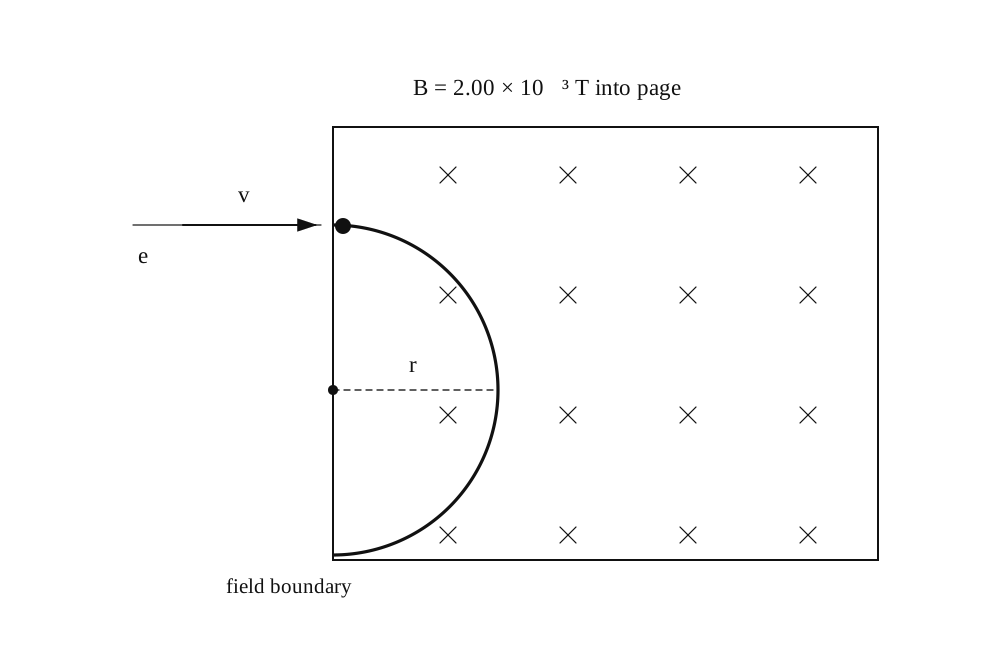
a)[2 marks]
Using magnetic force and centripetal force, show that .
b)[3 marks]
Calculate the electron's de Broglie wavelength.
c)[3 marks]
The accelerating potential difference is doubled while is unchanged. Determine the factor by which the orbital radius and de Broglie wavelength change. Explain.
WORKED SOLUTION
8 marksPractice marking scheme
ANSWER
(a) ; (b) ; (c) ,
Worked solution
a) Momentum relation
Answer: .
The magnetic force provides the centripetal force. Since ,
Cancelling one factor of ,
Since ,
b) de Broglie wavelength
Answer: .
First,
Then
c) Doubling the accelerating potential difference
Answer:
and
An electron accelerated from rest through potential difference gains kinetic energy
Therefore . Doubling makes the momentum times larger.
With unchanged,
so the radius increases by . Also,
so the wavelength decreases to of its original value.
Alternative approach: show , then use and .
Key insight: the same momentum inferred from the magnetic curvature also controls the de Broglie wavelength.
equates magnetic force and centripetal force correctly.
rearranges to .
determines .
applies .
obtains , with units.
establishes from electrical energy and kinetic energy.
determines .
determines .
Practice question aligned to the current QCAA syllabus; review the worked solution and marking criteria.
View the QCAA syllabusHow many marks did you earn?
Compare your working with the guide above.