Q143 · Practice questionComplex unfamiliar11 marks
QUESTION 143 (11 marks)
A rectangular coil of 500 turns is 4.0 cm wide and 5.0 cm high. The coil is released from rest with its lower edge level with the top boundary of a region of uniform magnetic field directed into the page, as shown. The field region is wider than the coil and has a vertical thickness .
The coil falls with its plane perpendicular to the field and with its sides vertical and horizontal. Assume that the magnetic force on the coil due to the induced current is negligible, so the coil falls with an acceleration of .
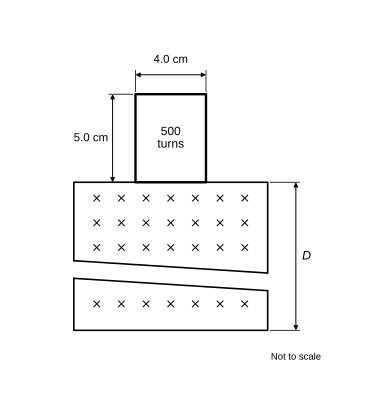
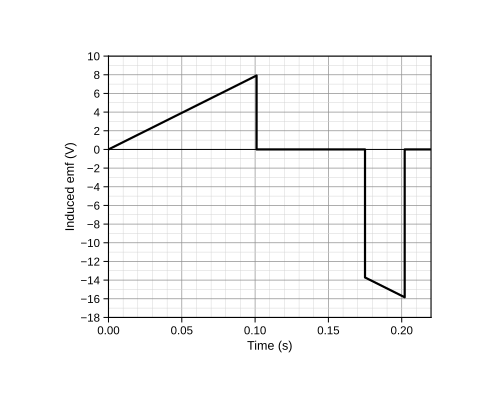
The graph shows the emf induced in the coil from the instant of release until the coil has completely left the field. The emf is defined to be positive when the induced current is anticlockwise as viewed in the diagram. The rapid changes in emf as the edges of the coil cross the boundaries of the field have been idealised as instantaneous.
a)[3 marks]
Explain, with reference to magnetic flux and Lenz's law, why the induced emf is positive at first, then zero, and later negative.
b)[3 marks]
Determine the magnitude of the magnetic field strength. Show your working.
c)[3 marks]
Determine the vertical thickness of the field region. Show your working.
d)[2 marks]
A student states: "The emf pulse as the coil leaves the field is larger than the pulse as the coil enters, so more magnetic flux passes through the coil as it leaves."
Evaluate this statement.
WORKED SOLUTION
11 marksPractice marking scheme
ANSWER
(a) Positive, zero, then negative emf as the flux changes. (b) . (c) . (d) The statement is incorrect; the flux changes have equal magnitudes.
Worked solution
Key insight. The area under an emf–time graph equals . The exit pulse is taller (the coil is faster) and narrower, but its area equals the entry pulse's area: the same flux is added and removed.
Part a · 3 marks
- Positive: as the coil enters, the flux into the page through it increases. By Lenz's law the induced current opposes this by producing a field out of the page inside the coil, so the induced current is anticlockwise (positive).
- Zero: when the whole coil is inside the uniform field the flux through it is constant (even though the coil is moving), so no emf is induced.
- Negative: as the coil leaves, the flux into the page decreases. The induced current opposes this by producing a field into the page, so it is clockwise (negative).
the positive emf (flux into the page increasing; anticlockwise current)
the zero emf (flux constant while fully inside the field)
the negative emf (flux decreasing; clockwise current)
Part b · 3 marks
While the coil is entering, the flux changes because the area inside the field grows: , so
Method 1 (gradient). The graph is a straight line through the origin with gradient . Since , , so
Method 2 (area). Area of the entry triangle , so
.
Method 3 (peak value). At , , so .
Tolerance: –.
recognises the relationship linking emf, and the coil's motion or flux change (e.g. ; area )
determines suitable quantities from the graph (gradient, area, or peak value with time)
calculates the magnetic field strength
Part c · 3 marks
The negative emf begins when the lower edge of the coil reaches the bottom boundary of the field, i.e. after the coil has fallen a distance from rest. From the graph this occurs at .
Alternative: the emf returns to zero at when the coil has fallen : , so .
Tolerance: time ; –.
identifies that the negative emf begins when the coil has fallen a distance (lower edge at the bottom boundary), or that it ends after
determines the relevant time from the graph
calculates using with
Part d · 2 marks
The statement is not correct. The exit pulse has a larger peak ( compared with ) because the coil is moving faster, so the flux changes at a greater rate. But the exit pulse lasts a much shorter time. The area under each pulse is :
- entry:
- exit:
The areas are equal, so the magnitude of the change in flux is the same on entry and exit ( in both cases).
Alternative accepted for the second mark: an argument without calculating areas, that the flux through each turn changes from to on entry and from to on exit — the same change in flux — so the statement is invalid. (Area under an emf–time graph is an extension of the Unit 2 area-under-graph skill; this route avoids depending on it.)
recognises that the larger emf on exit results from a faster rate of change of flux (coil moving faster), over a shorter time
compares the areas under the pulses, shows they are equal, and concludes the statement is invalid
Practice question aligned to the current QCAA syllabus; review the worked solution and marking criteria.
View the QCAA syllabusHow many marks did you earn?
Compare your working with the guide above.