Q140 · Practice questionComplex familiar1 mark
QUESTION 140
A charged particle moves through a low-pressure gas in a region of uniform magnetic field directed into the page. Collisions with gas atoms cause the particle to lose kinetic energy, so its speed decreases along its path.
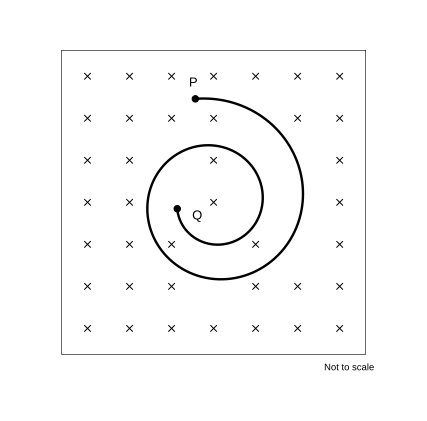
The track of the particle between points P and Q is shown.
Which row correctly identifies the sign of the charge on the particle and the direction in which the particle travelled along the track?
(A)
negative; P to Q
(B)
positive; P to Q
(C)
negative; Q to P
(D)
positive; Q to P
WORKED SOLUTION
1 markAnswer A
ANSWER
A
Worked solution
Answer: (A) negative, P to Q.
Key insight. The track alone does not show which way the particle went. Two ideas fix it: the radius of a track in a magnetic field encodes the speed, and the sense of curvature encodes the sign of the charge.
Reasoning.
1. The magnetic force supplies the centripetal force: , so . The radius is proportional to speed.
2. The particle loses energy, so its speed and therefore its radius decrease along the path. The end with the smaller radius (Q) is reached last: the particle travelled P to Q.
3. Travelling from P to Q the particle circulates clockwise as viewed. At the right-hand side of a clockwise circle the velocity is down the page. For a positive charge with into the page, the right-hand rule gives a force to the right — outward, away from the centre. That cannot provide the centripetal force, so the charge is negative.
Why the other options are wrong.
- (B) positive, P to Q — correct direction of travel, but the right-hand rule is applied to the wrong sign. A positive charge moving clockwise in a field into the page would be pushed outward. Misconception: force on a negative charge is not reversed relative to a positive one.
- (C) negative, Q to P — chooses the correct sign for clockwise motion, but if the particle travelled Q to P it would be moving anticlockwise, which would require a positive charge. Misconception: treating the direction of travel and the sign of the charge as independent.
- (D) positive, Q to P — this pair is consistent with the direction of the magnetic force (a positive charge circulates anticlockwise when the field is into the page), which makes it the most attractive distractor. It fails because Q to P means the radius grows, which would require the particle to gain speed. Misconception: ignoring the information that the particle loses energy.
Marking. 1 mark for (A). Alternative approaches: elimination using the force direction (leaves A or D) followed by the energy-loss condition.
Selects option A.
Practice question aligned to the current QCAA syllabus; review the worked solution and marking criteria.
View the QCAA syllabus