QCE Economics · Original practice questions with worked solutions
Practise the interest-rate transmission mechanism and evaluate policy using the conditions in the stimulus. Link the instrument to decisions and objectives.
Key ideas
Explain how an interest-rate change can affect borrowing costs, saving, consumption and investment.
Exchange rates and confidence can influence transmission; use the relationships supported by the scenario.
Consider time lags, spare capacity, inflation pressures and distributional effects when judging effectiveness.
Worked example
A higher cash rate may raise variable borrowing costs, reduce disposable income for borrowers and weaken consumption, reducing aggregate-demand pressure.
A common mistake
A rate cut does not guarantee stronger spending: weak confidence or existing debt can limit the response.
Try these questions
Attempt each question before revealing the worked solution. Saved questions and checked answers also appear in the main bank on this device. Exam marks are recorded after marking a practice exam.
The overnight interbank cash rate is the monetary-policy benchmark. Retail loan and deposit rates are influenced by it but also reflect funding costs, competition and risk.
Select A.
[1 mark]
Q59 · Practice questionComplex familiar4 marks
QUESTION 59 (4 marks)
A government refinances a $40 billion debt parcel. Its annual interest rate rises from 3% to 5%. Calculate the additional annual interest bill, assuming no principal repayment. Explain one opportunity cost for economic management.
Initial interest = 40 × 0.03 = $1.2 billion; new interest = 40 × 0.05 = $2 billion. The additional $0.8 billion must be funded by revenue, further borrowing or reallocating spending. An opportunity cost could be the best alternative training or infrastructure expenditure forgone. The calculation applies only to this refinanced parcel, not every government debt instrument.
Calculates both interest amounts and the $0.8 billion increase.
[2 marks]
Explains a relevant fiscal opportunity cost with an example.
[2 marks]
Q62 · Practice questionComplex familiar6 marks
QUESTION 62 (6 marks)
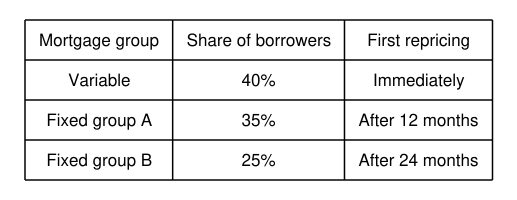
Assume a higher cash rate raises all relevant mortgage rates when contracts first reprice. Use the data to explain the direct mortgage cash-flow effect immediately and after 12 months. Evaluate the claim that unchanged consumption in the first month proves monetary policy has failed.
40% initially exposed and 75% after 12 months; early consumption alone is inconclusive.
Variable borrowers face higher debt servicing first. Once group A resets, 40 + 35 = 75% has been exposed to repricing; the final group resets later. Consumption responses may also be delayed or cushioned by savings. Employment, exchange rates and expectations are other channels. A one-month observation cannot capture the full lagged effect.
Uses both borrower shares accurately.
[2 marks]
Explains contract repricing and consumption lags.
[2 marks]
Evaluates the early-failure claim with another relevant channel.