QUESTION 91 (20 marks)
A drought disrupts food production and freight. Use all four sources to evaluate a broad cash rebate against targeted freight repair. Recommend a response using price stability and full employment. Explain how monetary policy could complement the chosen response.
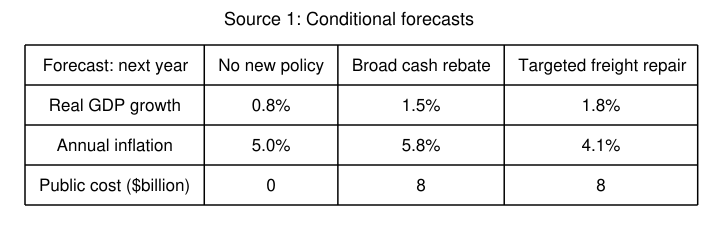
Source 1
The forecasts assume unchanged monetary settings and exclude additional unknown shocks.
Source 2
Businesses report that damaged freight links, rather than weak orders, are their main production constraint. Repairs can be substantially completed within nine months.
Source 3
The rebate reaches households within one month. Low-income households face immediate difficulty purchasing essential food.
Source 4
Inflation expectations have increased. Most mortgages are variable-rate, but employment is already weakening.
Practice marking scheme
Answer
Targeted repair is the stronger main response on the supplied forecasts; temporary targeted household relief and careful monetary restraint may complement it.
Working
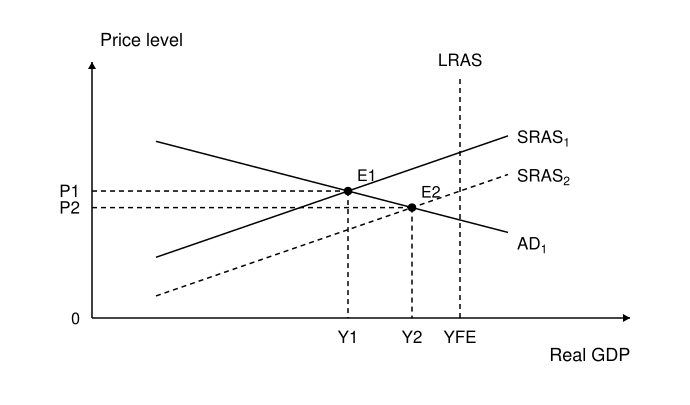
Source 2 identifies a supply bottleneck, so simply increasing spending does not repair the cause. In Source 1, repair raises growth 1.0 percentage point above baseline while reducing inflation 0.9 point; the rebate raises growth 0.7 point but adds 0.8 point to inflation. At equal $8 billion public cost, repair better reconciles output/employment and prices. Its nine-month implementation lag leaves vulnerable households exposed (Source 3), supporting limited, targeted relief rather than an indiscriminate rebate. Source 4 raises concern about persistent expectations: monetary policy may restrain demand and anchor them, but cannot manufacture food or fix roads, and strong tightening would add employment and mortgage pressure. A staged mix is justified, with monitoring of repair delivery and inflation persistence. Forecasts are conditional; another conclusion needs to confront both the bottleneck and household hardship.
Marking criteria
- Identifies the supply shock and distinguishes demand relief from restored capacity. [3 marks]
- Uses the two forecast comparisons and equal fiscal costs. [4 marks]
- Integrates household hardship and repair timing. [3 marks]
- Evaluates the two stated objectives and justifies a recommendation. [4 marks]
- Explains monetary complementarity, expectations and employment trade-offs. [4 marks]
- Qualifies the forecasts and acknowledges a defensible alternative. [2 marks]
Practice question aligned to the current QCAA syllabus; review the worked solution and marking criteria.
View the QCAA syllabusCompare your working with the guide above.