QCE Economics · Original practice questions with worked solutions
Practise evaluating monetary, fiscal and other economic policies. Build a chain from the policy instrument to behaviour, aggregate demand or supply, and the objective being assessed.
Key ideas
Explain a transmission mechanism rather than asserting that a policy works. For example, interest rates can affect borrowing, saving, spending and investment.
Consider timing, magnitude, constraints and unintended effects. Policy outcomes depend on economic conditions and responses by households and firms.
Use stimulus evidence to weigh benefits and costs against the stated objective, then give a supported judgment.
Worked example
A lower policy interest rate may reduce borrowing costs and support consumption and investment. Whether this raises real output or mainly prices depends partly on spare capacity and other conditions.
A common mistake
Expansionary policy is not automatically appropriate. An evaluation must consider inflation, capacity, time lags and competing objectives.
Try these questions
Attempt each question before revealing the worked solution. Saved questions and marks also appear in the main bank on this device.
Q13 · Practice questionSimple familiar1 mark
QUESTION 13
Without a new government decision, unemployment-benefit payments rise during a downturn. This is an example of
Working Existing eligibility rules increase transfers as unemployment rises. This supports household income and dampens the fall in demand without a new discretionary policy decision.
Marking criteria
Select D. [1 mark]
Practice question aligned to the current QCAA syllabus; review the worked solution and marking criteria.
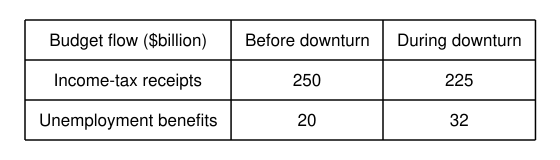
Tax rates and benefit eligibility rules are unchanged. Use the data to calculate the combined change in the budget balance. Explain how these changes act as automatic stabilisers.
Answer The balance deteriorates by $37 billion; both changes cushion the fall in private demand.
Working Revenue falls $25 billion and benefit expenditure rises $12 billion. Revenue minus spending therefore decreases by $37 billion. Lower tax liabilities retain more income in private hands, while transfers support unemployed households. These responses moderate the contraction without new discretionary decisions; they do not eliminate the downturn.
Marking criteria
Calculates the $37 billion deterioration. [1 mark]
Explains both automatic fiscal mechanisms. [2 marks]
Links disposable income and consumption to stabilisation. [2 marks]
Practice question aligned to the current QCAA syllabus; review the worked solution and marking criteria.
A government’s deficit rises from $20 billion to $30 billion. Its estimated cyclical deficit rises from $5 billion to $25 billion. Calculate the structural deficit in each period and assess the claim that the larger headline deficit proves discretionary fiscal policy became more expansionary.
Answer Structural deficit: $15 billion then $5 billion; the headline change does not prove discretionary expansion.
Working Using total deficit = cyclical + structural deficit, the estimates are 20 − 5 = 15 and 30 − 25 = 5 billion. The underlying deficit narrows by $10 billion while the cycle worsens the headline balance. This is consistent with a less expansionary underlying position. Structural estimates are uncertain and do not by themselves identify every policy measure.
Marking criteria
Calculates both structural estimates. [2 marks]
Distinguishes cyclical deterioration from underlying change. [2 marks]
Qualifies the inference rather than relying on the headline deficit. [1 mark]
Practice question aligned to the current QCAA syllabus; review the worked solution and marking criteria.