QCEVault

Macroeconomic objectives and theory practice

QCE Economics · Original practice questions with worked solutions

Practise interpreting inflation, growth, employment and economic models. Use the stimulus to establish what changed, then explain the mechanism and any trade-offs.

Key ideas

  • Distinguish a level from a rate of change. A fall in inflation means prices are rising more slowly, unless inflation becomes negative.
  • Real GDP removes the effect of price changes from measured output. Real GDP per capita also accounts for population size.
  • Use aggregate demand and aggregate supply to explain the expected effects of a change, stating the assumptions and distinguishing short-run from longer-run effects.

Worked example

If nominal GDP increases by 6% and the relevant price index by 4%, the exact real growth calculation is 1.06/1.04−1≈1.92%1.06/1.04-1\approx1.92\%. The subtraction approximation gives about 2%.

A common mistake

A change from 4% to 3% is a decrease of one percentage point, not a 1% proportional decrease.

Try these questions

Attempt each question before revealing the worked solution. Saved questions and marks also appear in the main bank on this device.

Q1 · Practice questionSimple familiar1 mark

QUESTION 1

A hypothetical cash rate falls from 4.35% to 3.85%. The decrease is

(A)
0.5 basis points.
(B)
50 percentage points.
(C)
50 basis points.
(D)
11.5 percentage points.
Question linkSyllabus coverage
Q31 · Practice questionSimple familiar4 marks

QUESTION 31 (4 marks)

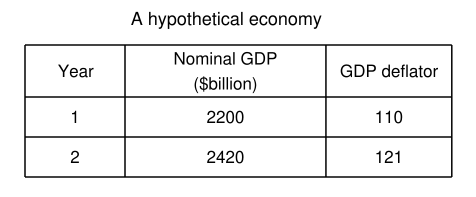
Use the data to calculate real GDP in each year and its percentage change. Explain why nominal growth gives a different impression.

Economics diagram for ECO26-ORIG-031
Question linkSyllabus coverage
Q32 · Practice questionSimple familiar4 marks

QUESTION 32 (4 marks)

A worker’s weekly wage rises from $1250 to $1312.50. Over the same period the CPI rises from 125 to 130. Calculate the percentage change in real wages, using the ratio method. Explain the result.

Question linkSyllabus coverage

All macroeconomic objectives and theory practice questions

38 original questions · Page 1 of 2

  1. Q1 · Original practice · 1 mark
    A hypothetical cash rate falls from 4.35% to 3.85%. The decrease is
    Macroeconomic objectives and theory
  2. Q2 · Original practice · 1 mark
    A worker receives a 4% increase in nominal wages while consumer prices rise by 6%. Their purchasing power
    Macroeconomic objectives and theory
  3. Q3 · Original practice · 1 mark
    A household has disposable income of 1000andconsumptionof1000 and consumption of 850. When income rises to 1100,consumptionrisesto1100, consumption rises to 920. Its initial APC and its MPC are, respectively,
    Macroeconomic objectives and theory
  4. Q4 · Original practice · 1 mark
    Which change directly increases aggregate demand, all else equal?
    Macroeconomic objectives and theory
  5. Q5 · Original practice · 1 mark
    In a simple closed economy with no taxation, the marginal propensity to save is 0.20. The simple Keynesian multiplier is
    Macroeconomic objectives and theory
  6. Q6 · Original practice · 1 mark
    In a five-sector circular-flow model, total injections are 260billionandtotalleakagesare260 billion and total leakages are 290 billion. If these flows persist initially, the model predicts
    Macroeconomic objectives and theory
  7. Q7 · Original practice · 1 mark
    Annual inflation falls from 5% to 2%, and the CPI continues to rise. This is
    Macroeconomic objectives and theory
  8. Q8 · Original practice · 1 mark
    A café employee works 12 hours each week, wants more hours and is available to work them. This worker is
    Macroeconomic objectives and theory
  9. Q9 · Original practice · 1 mark
    The non-accelerating inflation rate of unemployment is best described as the unemployment rate
    Macroeconomic objectives and theory
  10. Q10 · Original practice · 1 mark
    The diagram shows a change from E1 to E2. Which event could generate the change, ceteris paribus?
    Macroeconomic objectives and theory
  11. Q11 · Original practice · 1 mark
    The diagram shows a change from E1 to E2. A likely cause is
    Macroeconomic objectives and theory
  12. Q12 · Original practice · 1 mark
    On the supplied PPC, moving from B to A represents
    Macroeconomic objectives and theory
  13. Q23 · Original practice · 1 mark
    If households expect prices to rise rapidly next year, they may bring purchases forward. Initially, this can
    Macroeconomic objectives and theory
  14. Q28 · Original practice · 1 mark
    Real GDP rises by 3% while population rises by 4%. Real GDP per capita
    Macroeconomic objectives and theory
  15. Q31 · Original practice · 4 marks
    Use the data to calculate real GDP in each year and its percentage change. Explain why nominal growth gives a different impression.
    Macroeconomic objectives and theory
  16. Q32 · Original practice · 4 marks
    A worker’s weekly wage rises from 1250to1250 to 1312.50. Over the same period the CPI rises from 125 to 130. Calculate the percentage change in real wages, using the ratio method. Explain the result.
    Macroeconomic objectives and theory
  17. Q33 · Original practice · 4 marks
    Calculate annual inflation in Years 2 and 3. Explain whether Year 3 represents deflation or disinflation.
    Macroeconomic objectives and theory
  18. Q34 · Original practice · 5 marks
    In a simple closed economy without taxation, household disposable income rises by 200millionandconsumptionrisesby200 million and consumption rises by 150 million. Calculate MPC, MPS and the multiplier. Estimate the final income increase from an additional autonomous…
    Macroeconomic objectives and theory
  19. Q35 · Original practice · 5 marks
    Calculate APC and APS at each income level, then MPC between the two observations. Explain why using APC in the simple multiplier would be inappropriate.
    Macroeconomic objectives and theory
  20. Q36 · Original practice · 4 marks
    A hypothetical…
    Macroeconomic objectives and theory
  21. Q37 · Original practice · 4 marks
    A simple multiplier estimate assumes households spend 80% of additional income on domestic goods. In practice some spending goes to imported products and some income is taxed. Explain why the original estimate may overstate domestic output growth.
    Macroeconomic objectives and theory
  22. Q38 · Original practice · 4 marks
    Calculate total leakages and injections. Predict the initial pressure on national income, then calculate the export value that would balance these flows if the other values were unchanged.
    Macroeconomic objectives and theory
  23. Q39 · Original practice · 6 marks
    A successful Australian film-production hub attracts additional overseas orders. Assume unused productive capacity and no immediate change in production costs. Explain the initial effect using an AD/AS diagram that you draw and label.
    Macroeconomic objectives and theory
  24. Q40 · Original practice · 6 marks
    Flood damage closes a major freight route and raises delivery costs across many industries. Explain the short-run effects using a labelled AD/AS diagram. Distinguish this event from demand-pull inflation.
    Macroeconomic objectives and theory