QUESTION 97 (20 marks)
A central bank is considering another cash-rate increase after several recent increases. Use all sources to evaluate further tightening against holding the current rate. Recommend a stance using price stability and full employment.
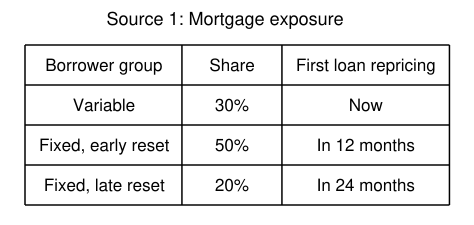
Source 1
The contracts protect the fixed groups from immediate mortgage repricing.
Source 2
Under a hold, inflation is forecast to fall from 4.5% now to 2.8% in two years; unemployment is forecast to rise by 0.7 percentage point.
Source 3
Further tightening is forecast to produce 2.0% inflation in two years and increase unemployment by 1.2 percentage points. The forecasts have substantial error bands.
Source 4
Deposit holders benefit from higher rates, but many heavily indebted households have little saving. Long-term inflation expectations remain within the target range.
Practice marking scheme
Answer
Holding is better supported by the given forecasts, while monitoring persistence and the mortgage reset wave.
Working
Only 30% of borrowers face immediate repricing; another 50% resets in a year, so 80% will then be exposed to the existing tightening (Source 1). A weak immediate consumption response could therefore understate the later cash-flow effect. The hold forecast returns inflation to 2.8%, within target, with a smaller unemployment increase than further tightening (Sources 2–3). The extra tightening improves the inflation forecast by 0.8 point but adds 0.5 point to the unemployment increase. Anchored expectations (Source 4) reduce, though do not remove, the case for urgent extra restraint. Borrowers’ liquidity and different saver/borrower propensities affect aggregate consumption. Prefer a hold on this evidence, reassessing if supply conditions or expectations worsen. Forecast uncertainty means this is a conditional judgement, not proof that a rise could never be justified.
Marking criteria
- Calculates the 80% one-year repricing exposure and explains lags. [3 marks]
- Uses both inflation and unemployment forecast comparisons. [4 marks]
- Integrates expectations and saver/borrower distribution. [3 marks]
- Evaluates the dual-objective trade-off. [4 marks]
- Makes a justified conditional stance recommendation. [4 marks]
- Explains forecast uncertainty and an appropriate monitoring trigger. [2 marks]
Practice question aligned to the current QCAA syllabus; review the worked solution and marking criteria.
View the QCAA syllabusCompare your working with the guide above.