QUESTION 3 (9 marks)
Ethanol can be produced by the fermentation of glucose or the hydration of ethene.
a) Describe the production of ethanol by fermentation of glucose by writing a balanced equation and indicating if a catalyst is required.
[3 marks]
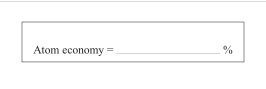
b) Calculate the atom economy for the production of ethanol by fermentation of glucose.
[2 marks]
c) In terms of atom economy, determine which process for the production of ethanol (i.e. hydration of ethene or fermentation of glucose) is greener.
[2 marks]
d) Identify two principles of green chemistry, other than atom economy, that make the production of ethanol by fermentation greener than by hydration.
[2 marks]
QCAA guide · typeset solution
QCAA sample response and mark allocation
3 | a) | C2H12O6(aq)yeast⎯⎯2CH3CH2OH(aq) + 2CO2(g) | • provides correct reactants and products [1 mark] • correctly balances the equation [1 mark] • indicates that yeast is required as a catalyst [1 mark] |

b) | Molar mass (ethanol) = 46.08 g Molar mass (glucose) = 180.18 g atom economy = 2×46.08180.18× 100atom economy = 2×46.08180.18× 100 = 51.148 % ≈51% Atom economy = 51% | • shows substitution correctly performed [1 mark] • determines atom economy [1 mark] | Allow FT error from incorrect molar masses. Do not penalise for incorrect decimal places/significant figures. | |
c) | • determines atom economy for hydration reaction is 100% [1 mark] • identifies that hydration reaction is greener [1 mark] | |||
d) | Use of renewable feedstocks Design for energy efficiency | • provides use of renewable feedstocks [1 mark] • provides design for energy efficiency [1 mark] |

QCAA sample response and marking criteria reproduced from the official guide.
Compare your working with the guide above.