QUESTION 29 (6 marks)
The oxidation of meso-hydrobenzoin (C14H14O2) to produce benzaldehyde (C7H6O) was carried out via three different reaction pathways to evaluate atom economy and E-factor.
Atom economy is a measure of reaction efficiency based on the percentage of the total mass of reactants successfully converted to the desired product. E-factor is a measure of environmental impact based on the mass of waste generated per kilogram of desired product.
molecular weight (desired product)
mass (waste) kg
molecular weight (reactants)
mass (desired product) kg
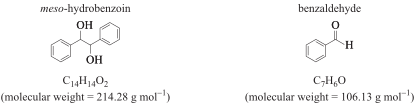
Reactants | Reaction pathway | Products | Benzaldehyde produced (kg) | E-factor |
1 C H O O + 14 14 2 2 2 | Na-MnOx catalyst | 2C7H6O + H2O | 1 | 5.2 |
C14H14O2+ NaIO4 | Malaprade oxidation | 2C7H6O + NaIO3+ H2O | 1 | 13.9 |
C14H14O2+ Pb(OAc)4 | Criegee oxidation | 2C7H6O + Pb(OAc)2+ 2AcOH | 1 | 3.2 |




a) Identify one principle of green chemistry, other than atom economy, that could be used in the production of benzaldehyde from meso-hydrobenzoin. Explain your reasoning.
[2 marks]
b) Evaluate the production of benzaldehyde from meso-hydrobenzoin in terms of atom economy and E-factor. Provide evidence for your reasoning.
[4 marks]
QCAA guide · typeset solution
QCAA sample response and mark allocation
29a) | Another principle of green chemistry used in the production of benzaldehyde is prevention, because it is better to prevent waste than to treat or clean it up after it has been created. | • identifies prevention as a green chemistry principle [1 mark] • explains that it is better to prevent waste than treat or clean it up after it has been created [1 mark] |
29b) | The Na-MnOx catalyst reaction pathway has the best atom economy, as it maximises the conversion of reactants into benzaldehyde. MW of desired product MW of reactants − 1 212.26 g mol 0.92 − 1 230.3 g mol Meanwhile, the Criegee oxidation reaction pathway has the lowest E-factor, indicating that it has the least environmental impact because it produces the least waste (3.2 kg) per kg of benzaldehyde produced. | • concludes that the Na-MnOx catalyst pathway has best atom economy [1 mark] • provides evidence to support atom economy claim [1 mark] • concludes that the Criegee oxidation pathway has the lowest environmental impact [1 mark] • provides E-factor evidence to support environmental impact claim [1 mark] |
QCAA sample response and marking criteria reproduced from the official guide.
Compare your working with the guide above.