QCEVault

Chemical synthesis — Question 7

QCAA 2025, Paper 2 · 4 marks

Q7 · 2025 · Paper 2Unclassified4 marks

QUESTION 7 (4 marks)

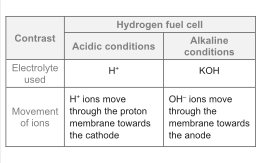
Contrast the operation of a hydrogen fuel cell under acidic conditions and a hydrogen fuel cell under alkaline conditions by completing the table.

Contrast

Hydrogen fuel cell

Acidic conditions

Alkaline conditions

Electrolyte used

Movement of ions

Note: If you make a mistake, cancel it by ruling a single diagonal line through your work and use the additional response space at the back of this book.

Related questions

  1. Q11 · 2025 QCAA · Paper 1 · 1 mark
    QUESTION 11 Yeasts are used in the production of ethanol by fermentation to (A) increase the rate of the reaction. (B) act as a reactant in the overall reaction. (C) increase the yield of ethanol and ensure its purity. (D) produce green ethanol by preventing the production of carbon dioxide.
    Chemical synthesis
  2. Q26 · 2025 QCAA · Paper 1 · 3 marks
    QUESTION 26  (3 marks) One step of the contact process involves reacting sulfur dioxide (SO2) and oxygen (O2) to produce sulfur trioxide (SO3), as shown. 2SO2(g) + O2(g)  2SO3(g) The equilibrium constant (Kc) for the forward reaction is 5.6 × 10⁴ at 350 °C and 9.2 × 101 at 800 °C. a) Determine whether the forward reaction is exothermic or endothermic. [1…
    Chemical synthesis
  3. Q29 · 2025 QCAA · Paper 1 · 6 marks
    QUESTION 29  (6 marks) The oxidation of meso-hydrobenzoin (C14H14O2) to produce benzaldehyde (C7H6O) was carried out via three different reaction pathways to evaluate atom economy and E-factor. Atom economy is a measure of reaction efficiency based on the percentage of the total mass of reactants successfully converted to the desired product. E-factor is a m…
    Chemical synthesis
  4. Q7 · 2024 QCAA · Paper 1 · 1 mark
    QUESTION 7 Which option is a principle of green chemistry? (A) avoid chemical derivatives (B) decrease energy efficiency (C) prevent catalytic reactions (D) minimise atom economy
    Chemical synthesis