QCEVault

Integration and applications of integration — Question 10

QCAA 2025, Paper 2 · 1 mark

Q10 · 2025 · Technology-activeSimple familiar1 mark

QUESTION 10

Consider the solid of revolution formed by rotating a section of the curve y=sin⁡(x)y=\sin(x) around the xx-axis.
Determine the volume of the solid of revolution.
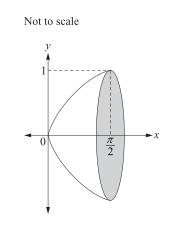
Solid of revolution formed from y equals sin x from x equals 0 to pi over 2, rotated about the x-axis.
(A)
0.79 units30.79\text{ units}^3
(B)
0.86 units30.86\text{ units}^3
(C)
2.47 units32.47\text{ units}^3
(D)
2.60 units32.60\text{ units}^3
Question linkOriginal paper

Related questions

  1. Q1 · 2025 QCAA · Paper 1 · 1 mark
    Use the substitution u=x2u=x^2 to express ∫2xex2 dx\displaystyle\int 2xe^{x^2}\,dx in terms of uu.
    Integration and applications of integration
  2. Q15 · 2025 QCAA · Paper 1 · 5 marks
    Integration by parts and area.
    Integration and applications of integration
  3. Q18 · 2025 QCAA · Paper 2 · 7 marks
    Polar curves are defined by points that are a variable distance of rr units from the origin and dependent on the angle θ\theta (in radians) measured from the positive xx-axis. Consider the polar curve r=1+cos⁡(θ)r=1+\cos(\theta). A table of four polar coordinates on this curve is shown.
    | θ\theta | rr | | --- | --- | | 00 | 22 | | π/6\pi/6 | 1+3/21+\sqrt3/2 | |…
    Integration and applications of integration
  4. Q2 · 2024 QCAA · Paper 1 · 1 mark
    Given that Ax−2+3x=x−6x(x−2)\dfrac{A}{x-2}+\dfrac3x=\dfrac{x-6}{x(x-2)}, determine the value of AA.
    Integration and applications of integration