Q13 · 2025 · Technology-activeSimple familiar7 marks
QUESTION 13 (7 marks)
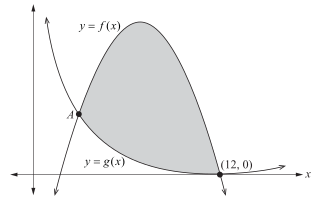
The sketch shows sections of the functions
and
Two points of intersection at and point are shown.
a)[1 mark]
Determine the coordinates of point .
b)[3 marks]
Consider the shaded bounded region between the functions. Determine an approximate area of this region using Simpson’s rule with four intervals. Show evidence of the values substituted into this rule in your solution.
c)[1 mark]
State a definite integral that represents the area of the shaded bounded region.
d)[1 mark]
Determine the value of your result from Question 13c). Give your answer to two decimal places.
e)[1 mark]
Other than working to more decimal places, state a strategy involving Simpson’s rule that could be used to improve the accuracy of your result from Question 13b).
WORKED SOLUTION
7 marksQCAA guide · typeset solution
ANSWER
; Simpson approximation units; exact-area value units.
Worked solution
a) Using a GDC, .
b) Method 1: using four intervals from to gives . For :
:
: .
Using Simpson’s rule,
Alternative method 2: apply Simpson’s rule separately to and using
:
:
: .
For ,
For ,
Therefore the required area is approximately
c) The exact area is represented by
d) .
e) The accuracy could be improved by using more intervals (an even number).
correctly determines point
correctly recognises the requirement to determine the relevant function values for Simpson’s rule
shows evidence of use of Simpson’s rule
determines the required approximate area
correctly determines a definite integral, including the term, that represents the exact area
determines the rounded value of the exact area
correctly states a suitable strategy
One QCAA sample method typeset for web; criterion wording is adapted from the official marking guide.
View the full QCAA marking guideHow many marks did you earn?
Compare your working with the guide above.