Q18 · 2025 · Technology-activeComplex unfamiliar7 marks
QUESTION 18 (7 marks)
Polar curves are defined by points that are a variable distance of units from the origin and dependent on the angle (in radians) measured from the positive -axis.
Consider the polar curve .
A table of four polar coordinates on this curve is shown.
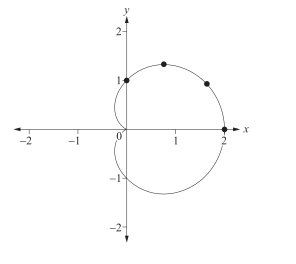
The graph shows the polar curve for on a Cartesian plane. The polar coordinates from the table have been plotted on the curve.
The length of a polar curve, , from to can be determined using the rule
Use a complete algebraic method to determine the length of the section of the given polar curve that lies above the -axis.
WORKED SOLUTION
7 marksQCAA guide · typeset solution
ANSWER
units.
Worked solution
The section above the -axis corresponds to . Since
Expand and use :
Using ,
where the cosine is non-negative on the interval. Thus
correctly determines the values of and by considering the curve length above the -axis
correctly determines
determines an expression for the integrand in expanded form
uses a suitable identity to determine a simplified integrand
uses a suitable double-angle identity within the integrand
uses a suitable integration method to determine an expression for
determines the required length
One QCAA sample method typeset for web; criterion wording is adapted from the official marking guide.
View the full QCAA marking guideHow many marks did you earn?
Compare your working with the guide above.