Q12 · 2024 · Technology-freeSimple familiar7 marks
QUESTION 12 (7 marks)
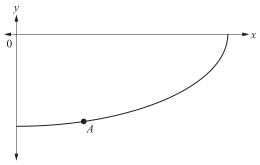
Point A lies on a section of the ellipse as shown.
The coordinates of A are .
a)[2 marks]
Determine the value of .
b)[2 marks]
Use implicit differentiation to determine an expression for in terms of and .
c)[1 mark]
Use your results from Questions 12a) and 12b) to determine the gradient of the tangent to the curve at A.
d)[2 marks]
Consider the region between the given section of the ellipse, the -axis and the lines and . Determine the volume of the solid of revolution formed by rotating this region about the -axis. Express your answer in simplest form.
WORKED SOLUTION
7 marksQCAA guide · typeset solution
ANSWER
; ; gradient ; volume units.
Worked solution
a) Substituting gives . Since A lies in quadrant IV, .
b) Implicit differentiation gives , hence .
c) At A, the gradient is .
d)
correctly substitutes into the equation
evaluates reasonableness of the solution to determine the -coordinate of A
correctly uses implicit differentiation
expresses in terms of and
determines the gradient of the tangent at A
correctly determines a definite integral that represents the required volume
determines volume in simplest form
One QCAA sample method typeset for web; criterion wording is adapted from the official marking guide.
View the full QCAA marking guideHow many marks did you earn?
Compare your working with the guide above.