Q11 · 2023 · Technology-activeSimple familiar4 marks
QUESTION 11 (4 marks)
The bounded region between the graphs of the functions and over a certain domain is shaded as shown. The functions intersect at the origin and point A.
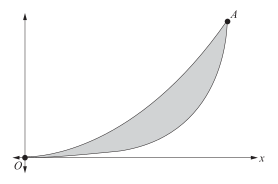
a)[1 mark]
Determine the coordinates of point A.
b)[1 mark]
Calculate the area of the shaded region.
c)[2 marks]
The shaded region is rotated about the -axis to form a solid of revolution. Determine the volume of the solid formed.
WORKED SOLUTION
4 marksQCAA guide · typeset solution
ANSWER
; area units; volume units.
Worked solution
a) Using a GDC to solve the intersection gives .
b) The area of the bounded region is units.
c) A washer integral is
which gives units.
determines the coordinates of A
calculates the area of the shaded region
determines a definite integral that represents the volume
determines the volume of the solid
One QCAA sample method typeset for web; criterion wording is adapted from the official marking guide.
View the full QCAA marking guideHow many marks did you earn?
Compare your working with the guide above.