QUESTION 2 (12 marks)
Salicylic acid reacts with ethanoic anhydride in an aqueous solution to produce acetylsalicylic acid, as shown in the equation. Acetylsalicylic acid is commonly known as aspirin.
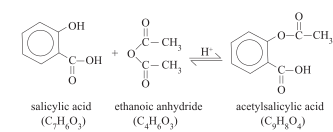
O + CH3 C OH
ethanoic acid (C2H4O2)
a) Identify the type of chemical reaction used to produce aspirin.
[1 mark]
b) Write the equilibrium expression, Kc, for the reaction.
[1 mark]
3 2 10-
c) At 20 °C, the equilibrium constant (Kc) for the reaction is
. Determine whether the ́
concentration of the reactants or products is greater at equilibrium at this temperature.
[2 marks]
d) Calculate the minimum mass of salicylic acid required to produce 500.0 mg of aspirin if the yield of aspirin is 45.0%. Show your working.
[4 marks]
e) When the reaction is heated to 40 °C and equilibrium is re-established, the concentration of acetylsalicylic acid and ethanoic acid increases. Apply Le Châtelier’s principle to predict if the forward reaction is exothermic or endothermic. Explain your reasoning.
[4 marks]
QCAA guide · typeset solution
QCAA sample response and mark allocation
2 | a) | Esterification K | • identifies the reaction as esterification [1 mark] | |
b) | KKc = [CC9HH8OO4][CC2HH4OO2][CC7HH6OO3][CC4HH6OO3] | • provides[CC9HH8OO4][CC2HH4OO2][CC7HH6OO3][CC4HH6OO3][1 mark] | ||
c) | KKc < 1 The equilibrium lies towards the reactants, therefore, the concentration of the reactants is greater than the concentration of the products. | • identifies that equilbrium lies towards the reactants [1 mark] • identifies that reactants > products [1 mark] | ||
d) | Molar mass of aspirin = (12.01 x 9) + (16.00 x 4) + 8.08 = 180.17 g Moles of aspirin produced = 0.5 g / 180.17 g = 2.78 × 10⁻³ mol | • determines molar mass of aspirin is 180 g [1 mark] | Allow FT error from naspirin. |



Ratio 1:1 45.0% efficient 2.78 × 10 −3 Moles of salicylic acid = = 6.17 × 10⁻³ mol 0.45 Mass of salicylic acid = 6.17 × 10−3 × 138.13 = 0.852 g = Mass = 852 mg (to three significant figures) | • determines naspirin =2.78 × 10⁻³[1 mark]• determines nacid[1mark]• determines mass [1mark] | Do not penalise for incorrect decimal place significant figures. Do not penalise for incorrect decimal places/ significant figures. | ||
e) | An increase in KKc means that equilibrium has shifted towards the products. An increase in temperature shifts equilibrium in the endothermic direction. Le Châtelier’s principle means that when a system at equilibrium experiences an increase in temperature, the equilibrium shifts in the endothermic direction to decrease the temperature. As the forward reaction increases, the system as written must be endothermic. | • identifies that increased temperature means increased products [1 mark] • identifies that equilibrium has shifted in the endothermic direction [1 mark] • uses Le Châtelier’s principle to explain a shift in equilibrium for an increase in temperature [1 mark] • identifies the forward reaction as endothermic [1 mark] | Allow FT error from an increase in temperature shifting equilbrium towards reactants. |

QCAA sample response and marking criteria reproduced from the official guide.
Compare your working with the guide above.