Q12 · 2025 · Technology-activeSimple familiar7 marks
QUESTION 12 (7 marks)
A 10 kg object is travelling at ground level with a constant velocity.
At an instant, two forces of 60 N and 42 N act simultaneously on the object parallel to the ground in the directions shown.
Let unit vectors in the east and north directions be and respectively.
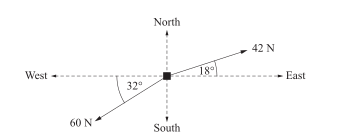
a)[2 marks]
Determine the resultant force acting on the object expressed in Cartesian form. Simplify your answer.
b)[1 mark]
Determine the acceleration of the object after the forces act. Leave your answer in Cartesian form.
c)[2 marks]
The object is initially travelling at in a northerly direction when the forces act. Determine an expression for the object’s velocity in terms of time, , after the forces act. Leave your answer in Cartesian form.
d)[2 marks]
Calculate the speed of the object after the forces have been acting for two seconds.
WORKED SOLUTION
7 marksQCAA guide · typeset solution
ANSWER
Resultant force N; speed after 2 s .
Worked solution
a)
b) From ,
c)
At , , so . Therefore
d) When ,
so the speed is
correctly resolves the given vectors
determines a simplified expression for the resultant force in Cartesian form
determines acceleration in Cartesian form
determines an expression for velocity
determines velocity based on the initial condition in Cartesian form
determines velocity when
determines speed when
One QCAA sample method typeset for web; criterion wording is adapted from the official marking guide.
View the full QCAA marking guideHow many marks did you earn?
Compare your working with the guide above.