QCEVault

Rates of change and differential equations — Question 10

QCAA 2024, Paper 2 · 1 mark

Q10 · 2024 · Technology-activeSimple familiar1 mark

QUESTION 10

The acceleration (m s−2^{-2}) of an object at time, tt, for 0≤t≤20\le t\le2 seconds is given by a=2t+1a=\dfrac{2}{t+1}.
Given that the object is initially at rest, its velocity–time graph is
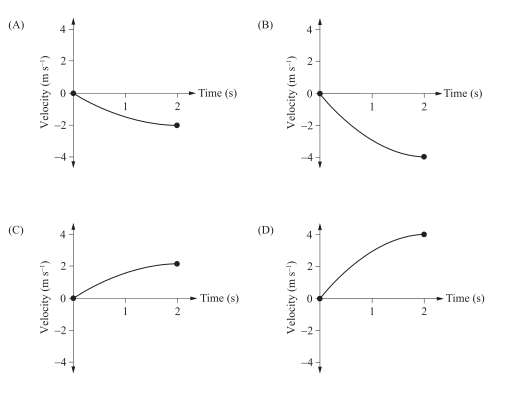
Four velocity–time graph options A to D for Question 10.
Question linkOriginal paper

Related questions

  1. Q13 · 2025 QCAA · Paper 1 · 5 marks
    The velocity (m s−1^{-1}) of a 3 kg object moving in a straight line is given by v=2cos⁡−1(x3),0≤x<3,v=2\cos^{-1}\left(\frac{x}{3}\right),\qquad0\le x<3, where xx is its position (m) from the origin.
    Rates of change and differential equations
  2. Q17 · 2025 QCAA · Paper 1 · 7 marks
    The radius of a cylinder decreases at a constant rate of 0.50.5 m s−1^{-1}, while maintaining a constant height of four metres. Given that the cylinder has an initial volume of 100π100\pi m3^3, determine the rate of change of the volume (m3^3 s−1^{-1}) of the cylinder after four seconds.
    Rates of change and differential equations
  3. Q18 · 2025 QCAA · Paper 1 · 6 marks
    An object is projected at an acute angle of θ\theta below the horizontal, with an initial speed of 30 m s−1^{-1} from a position 90 m above ground level. The object hits the ground 90 m horizontally from its projection point. Use vector calculus to determine θ\theta in its simplest form. Assume that the magnitude of mean acceleration due to gravity on Eart…
    Rates of change and differential equations
  4. Q6 · 2025 QCAA · Paper 2 · 1 mark
    Determine the gradient of the tangent to y2=4xy^2=4x when y=1y=1.
    Rates of change and differential equations