QCE Vault / Specialist Maths Rates of change and differential equations — Question 7 QCAA 2020, Paper 1 · 1 mark
Browse all questions Differential equations and related rates revision Original practice exam Report an issue Q7 · 2020 · Technology-free Simple familiar 1 mark
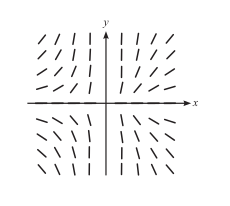
QUESTION 7 The diagram shows a slope field.
The differential equation represented by the slope field is
(A) d y d x = 5 y x \frac{dy}{dx}=\frac{5y}{x} d x d y = x 5 y (B) d y d x = 5 y 2 x \frac{dy}{dx}=\frac{5y^2}{x} d x d y = x 5 y 2 (C) d y d x = 5 y x 2 \frac{dy}{dx}=\frac{5y}{x^2} d x d y = x 2 5 y (D) d y d x = 5 y 2 x 2 \frac{dy}{dx}=\frac{5y^2}{x^2} d x d y = x 2 5 y 2 The field has zero slope on y = 0 y=0 y = 0 , positive slopes for y > 0 y>0 y > 0 and negative slopes for y < 0 y<0 y < 0 , independent of the sign of x x x . That requires a factor y y y in the numerator and an even power of x x x in the denominator, giving d y d x = 5 y x 2 \frac{dy}{dx}=\frac{5y}{x^2} d x d y = x 2 5 y . QCAA marking guide
Related questions Q13 · 2025 QCAA · Paper 1 · 5 marks The velocity (m s − 1 ^{-1} − 1 ) of a 3 kg object moving in a straight line is given by
v = 2 cos − 1 ( x 3 ) , 0 ≤ x < 3 , v=2\cos^{-1}\left(\frac{x}{3}\right),\qquad0\le x<3, v = 2 cos − 1 ( 3 x ) , 0 ≤ x < 3 ,
where x x x is its position (m) from the origin. Rates of change and differential equations Q17 · 2025 QCAA · Paper 1 · 7 marks The radius of a cylinder decreases at a constant rate of 0.5 0.5 0.5 m s − 1 ^{-1} − 1 , while maintaining a constant height of four metres.
Given that the cylinder has an initial volume of 100 π 100\pi 100 π m 3 ^3 3 , determine the rate of change of the volume (m 3 ^3 3 s − 1 ^{-1} − 1 ) of the cylinder after four seconds. Rates of change and differential equations Q18 · 2025 QCAA · Paper 1 · 6 marks An object is projected at an acute angle of θ \theta θ below the horizontal, with an initial speed of 30 m s − 1 ^{-1} − 1 from a position 90 m above ground level.
The object hits the ground 90 m horizontally from its projection point.
Use vector calculus to determine θ \theta θ in its simplest form.
Assume that the magnitude of mean acceleration due to gravity on Eart… Rates of change and differential equations Q1 · 2025 QCAA · Paper 2 · 1 mark Rounded to the nearest degree, an angle equivalent to the arctangent of 2 2 2 is Rates of change and differential equations