Q139 · Practice questionComplex familiar6 marks
QUESTION 139 (6 marks)
For hydrogen, . An atom emits a photon in the transition to .
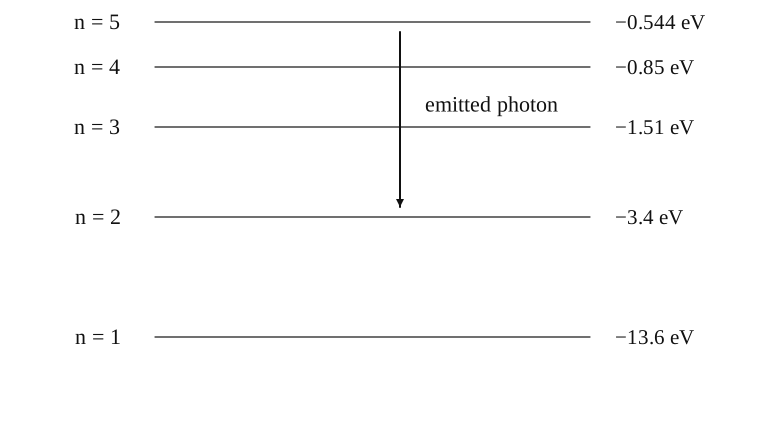
a)[3 marks]
Determine the photon energy in and joules.
b)[2 marks]
Calculate the wavelength.
c)[1 mark]
State whether the transition is emission or absorption and why.
ANSWER
It is emission because the electron moves to a lower energy state and releases energy as a photon.
Part (a): and , so photon .
Part (b): nm.
Part (c): It is emission because the electron moves to a lower energy state and releases energy as a photon.
Editorial practice rubric; not an official QCAA marking scheme. Equivalent correct methods are accepted. Method marks may be awarded after an earlier arithmetic error when the subsequent method is valid.
Part (a): Calculates the levels and .
Part (a): Obtains the positive emitted-photon energy .
Part (a): Converts to approximately .
Part (b): Uses with photon energy in joules.
Part (b): Obtains approximately or .
Part (c): States emission, because the electron falls to a lower energy state and releases a photon.