Q4 · 2025 · Paper 2Complex familiar8 marks
QUESTION 4 (8 marks)
An energy level diagram for an atom is shown.
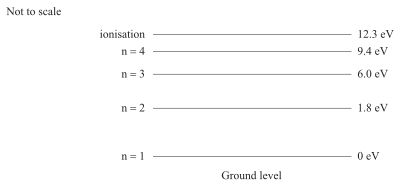
a)[1 mark]
An electron () transitions from the energy level to the energy level and emits a photon.
Calculate the magnitude of the energy change of the electron.
b)[3 marks]
A different electron () also transitions from to , but it emits two photons.
Explain how the transitions of electrons and result in three different photons.
c)[4 marks]
Determine the maximum wavelength of a photon that could be produced by the transitions of the two electrons in Questions 4a) and 4b). Show your working.
a)
Magnitude of energy change =
b) If a different electron () emits two photons, then one photon is emitted and the electron moves from to and the other photon is emitted as the electron moves from to . The three photons produced from and will have different wavelengths due to the different energies released between each level.
c) to photon will have the lowest energy of .
Maximum wavelength =
calculates energy change
explains that photons are released when electrons move down energy levels
explains that three photons are released due to the three transitions the electron can make
explains that photons are different due to the different energies at each level
determines that the to photon will have lowest energy
recognises that the scenario relates to the photoelectric effect
converts energy to J
determines maximum wavelength