Q6 · 2024 · Paper 2Complex unfamiliar11 marks
QUESTION 6 (11 marks)
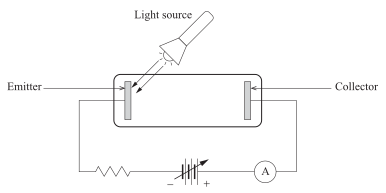
A photoelectric experiment was set up with a variable voltage between the collector and emitter, a resistor and an ammeter. There was no current detected when the light was off.
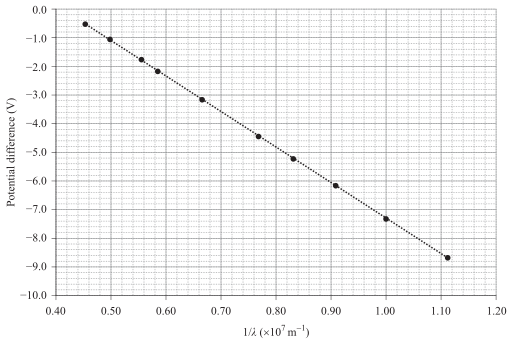
The potential difference required to reduce the current to was measured for different wavelengths of light.
a)[2 marks]
Determine the potential difference required to reduce the current to when light with a wavelength of is shone on the emitter. Show your working and refer to the graph.
b)[6 marks]
Use the graph to determine the work function of the emitter in eV. Show your working.
c)[3 marks]
The experiment was changed so that the variable voltage was removed and the light, with a frequency above the threshold frequency, was shining on the emitter. Predict the effect of increasing intensity from the light source on the current in the circuit. Explain your reasoning.
WORKED SOLUTION
11 marksQCAA guide · typeset solution
ANSWER
See worked solution below.
Worked solution
7
9
1
.
1
0
10
125 1
0 8
λ
−=
×
=
×
Refer to graph:
Potential difference = –4.8 V
E
hf
W
k =
−
For the stopping voltage, Vq
Ek
=
For (0.8 × 10⁷, –4.8):
34
8
7
18
18
19
(6.626 10
) (3 10 ) (0.8 10 )
1.59024 10
J
convert to eV
V
(1.59024 10
) (1.6 10
)
9.939 eV
4
e
.8
5
9.9
9
.
3
1
k
f
h
h
hf
E
h
W
W
c
f
W
λ
−
−
−
−
=
=
×
×
×
×
×
=
×
=
×
×
×
≈
=
=
−
=
−
Since the frequency is above the threshold frequency,
increasing the intensity of light will produce more photons
which, in turn, will increase the likelihood of more
photoelectrons being ‘knocked off’ from the metal surface.
More photoelectrons in the circuit will increase the current.
• determines inverse wavelength to
be
1
7
10
0.8
m−
×
[1 mark]
• determines the potential difference
from graph [1 mark]
• recognises the relationship
between
– maximum kinetic energy of
photoelectrons and work function
[1 mark]
– maximum kinetic energy of
photoelectrons and stopping
voltage [1 mark]
– frequency and wavelength of light
[1 mark]
• identifies appropriate data from the
graph [1 mark]
• shows appropriate mathematical
reasoning [1 mark]
• determines the work function in eV
[1 mark]
• explains that increasing light
intensity will increase the number of
photons [1 mark]
• explains there will be an increase in
the number of photoelectrons
ejected from the emitter [1 mark]
• explains there will be an increase in
current in the circuit [1 mark]
One QCAA sample method typeset for web; criterion wording is adapted from the official marking guide.
How many marks did you earn?
Compare your working with the guide above.