Q6 · 2022 · Paper 2Complex unfamiliar14 marks
QUESTION 6 (14 marks)
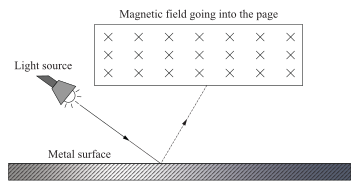
A light was shone onto a metallic surface and the subsequently released photoelectron passed through a magnetic field.
a)[1 mark]
Identify the direction the photoelectron would have curved as it passed through the magnetic field.
b)[4 marks]
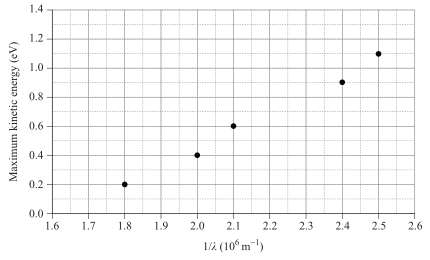
The graph shows the maximum kinetic energy of the photoelectron as the frequency of the light was changed. Determine the work function for the metal. Show your working. Give your answer to two significant figures.
c)[9 marks]
If the strength of the magnetic field is , determine the maximum radius of the photoelectron’s path through the magnetic field when light of wavelength was shone onto the metallic surface. Show your working. Give your answer to two significant figures.
WORKED SOLUTION
14 marksQCAA guide · typeset solution
ANSWER
See worked solution below.
Worked solution
The electron would have curved to the right.
The x-intercept corresponds to the threshold frequency for the
metal. Therefore, based on the line of best fit, the
corresponding wavelength is
m
6
1
606 n
1.
0
6
1
5
m
=
×
.
9
8
0
3.00
606
14
4.
10
9
10
5 10
c
f
Hz
λ
=
×
−
×
=
=
×
1
0
34
10
4.95 10
19
4
6.626
3.3 10
W
hf
J
=
=
−
×
×
×
−
=
×
Work function = 3.3 × 10⁻¹⁹ J (to two significant figures)
Inverse of wavelength =
1
1
2.2
m
9
45
1
0 10
6
0
=
×
−
−
×
Maximum kinetic energy of photoelectron:
.
19
19
1.6
1
0.7
1 12
10
0
E
J
k
−
−
×
×
=
×
=
Maximum velocity of photoelectron:
2
19
31 2
1.12 10
9.109 10
19
10
31
10
5
1
1
2
1
2
1.12
4.55
5.0 10 m s
E
mv
v
v
k
−
−
×
×
×
−
×
−
=
=
×
=
×
−
=
Force acting on photoelectron in the magnetic field:
19
5
6
1.6 10
5.0 10
5.0 10
sin 90
19
4.0
0
sin
1
F
qvB
N
θ
−
−
=
×
×
×
×
×
×
−
×
=
=
Radius of photoelectron’s path:
(
)
2
2
31
5
1
0
9.109
4
0
5.
10
19
1
.0
0.57
0
mv
F
r
r
r
m
−
×
×
×
−
×
=
=
=
Radius of photoelectron’s path = 0.57 m (to two significant
figures)
• identifies the direction of curvature [1 mark]
• determines the threshold frequency [1 mark]
• recognises the scenario relates to work function
[1 mark]
• provides appropriate reasoning [1 mark]
• determines the work function [1 mark]
• determines the corresponding inverse of
wavelength [1 mark]
• determines the maximum kinetic energy of the
photoelectron [1 mark]
• recognises the scenario relates to velocity of
photoelectrons [1 mark]
• determines the maximum velocity of the
photoelectron [1 mark]
• recognises the scenario relates to force on
photoelectrons [1 mark]
• determines the force on the photoelectron
[1 mark]
• recognises the scenario relates to the radius of the
circular path [1 mark]
• provides appropriate mathematical reasoning to
determine radius [1 mark]
• determines the maximum radius of the
photoelectron’s path [1 mark]
One QCAA sample method typeset for web; criterion wording is adapted from the official marking guide.
How many marks did you earn?
Compare your working with the guide above.