Q3 · 2020 · Paper 2Complex familiar5 marks
QUESTION 3 (5 marks)
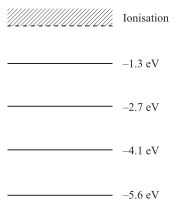
The diagram shows the atomic energy levels of the atoms in an unknown gas.
Predict the shortest wavelength of visible light that could be emitted from this unknown gas.
(Note: The range of visible wavelengths of light is between 400 nm and 700 nm.)
The shortest wavelength in the visible spectrum will have
the largest energy difference.
𝐸𝐸= ℎ𝑓𝑓
= ℎ𝑐𝑐
𝜆𝜆
= 6.626 × 10−34 × 3 × 108
400 × 10−9
= 4.9695 × 10⁻¹⁹ J
𝐸𝐸= 4.9695 × 10⁻¹⁹
1.60 × 10⁻¹⁹
≈3.106 eV
The largest transition below 3.106 eV is between−2.7 eV
and −5.6 eV.
𝐸𝐸= −2.7 − −5.6
= 2.9 eV
In joules,
𝐸𝐸= 2.9 × 1.60 × 10−19
= 4.64 × 10⁻¹⁹ J
𝐸𝐸= ℎ𝑐𝑐
𝜆𝜆
𝜆𝜆= ℎ𝑐𝑐
𝐸𝐸
= 6.626 × 10−34 × 3 × 108
4.64 × 10⁻¹⁹
Wavelength = 428 nm
Solution 1
• indicates an understanding of the physical
scenario in relation to the relationship between
wavelength of emitted light and the energy level
diagram [1 mark]
• provides pertinent mathematical operation/s
correctly performed to move between values for
wavelength and energy [1 mark]
• identifies the largest allowable energy transition for
visible light to be emitted (consequentially correct)
[1 mark]
• identifies the consequentially correct transition to
produce the shortest wavelength of visible light
[1 mark]
• determines the wavelength of light [1 mark]
OR
Solution 2
• indicates an understanding of the physical
scenario in relation to the relationship between
wavelength of emitted light and the energy level
diagram [1 mark]
• provides pertinent mathematical operation/s
correctly performed to calculate all energy
differences [1 mark]
• provides pertinent mathematical operation/s
correctly performed to identify all possible
wavelengths emitted by the atom [1 mark]
• identifies the consequentially correct wavelengths
within the visible spectrum [1 mark]
• determines the wavelength of light [1 mark]