QCEVault

Quantum theory — Question 26

QCAA 2020, Paper 1 · 3 marks

Q26 · 2020 · Paper 1Simple familiar3 marks

QUESTION 26 (3 marks)

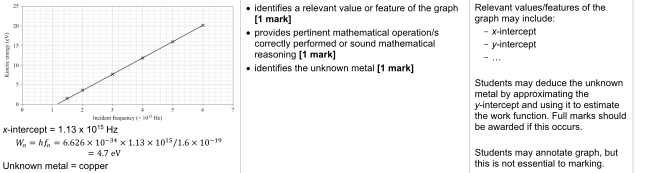
A photoelectric effect experiment was conducted by shining different frequencies of light on a plate made of an unknown metal. The graph shows the kinetic energies of ejected photoelectrons with respect to the frequency of incident light.
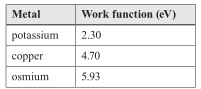
The table shows the work functions of various metals.
Determine which metal is most likely to have ejected the photoelectrons in this experiment.
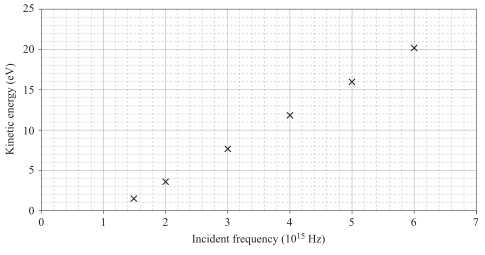
Graph of photoelectron kinetic energy versus incident frequency.
Question linkOriginal paper

Related questions

  1. Q7 · 2025 QCAA · Paper 1 · 1 mark
    What key feature differentiates the Bohr model of the atom from the Rutherford model?
    Quantum theory
  2. Q15 · 2025 QCAA · Paper 1 · 1 mark
    Questions 15–16 refer to the following scenario. Researchers conducted a photoelectric effect experiment in which light was shone on two unknown metals, R and X. The results were analysed to produce the graph shown.
    The graph for metal X has a theoretical gradient equivalent to
    Quantum theory
  3. Q16 · 2025 QCAA · Paper 1 · 1 mark
    Questions 15–16 refer to the following scenario. Researchers conducted a photoelectric effect experiment in which light was shone on two unknown metals, R and X. The results were analysed to produce the graph shown.
    The work function for metal R is
    Quantum theory
  4. Q20 · 2025 QCAA · Paper 1 · 1 mark
    When a black body is heated, a graph with a distinctive peak is produced, as shown.
    This black body curve can be used to demonstrate that
    Quantum theory