Q277 · Practice questionSimple familiar4 marks
QUESTION 277 (4 marks)
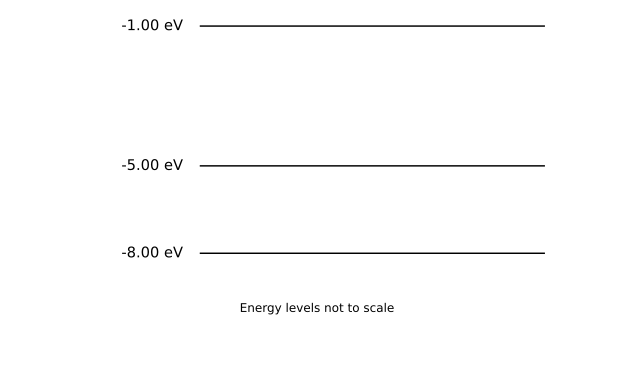
The diagram shows an idealised atom with three bound levels , and . An electron absorbs a photon from the ground state to the top level, then returns through the middle level in two emission steps. Use .
a)[2 marks]
Draw and label the absorption arrow and both emission arrows on the diagram.
b)[2 marks]
Calculate the two emitted wavelengths and identify which is longer.
ANSWER
(a) Absorption upward from -8 to -1 eV; emission downward from -1 to -5 eV and from -5 to -8 eV.
(b) and ; the lower-energy 3.00 eV transition gives the longer wavelength.
(a) Absorption increases atomic energy; emission decreases it. The two downward arrows must connect the actual intermediate state.
(b) The gaps are and . Hence and .
Equivalent physically justified methods, alternative valid sketches and consistent units accepted.
Accept sensible significant figures and consistent rounding from stated constants.
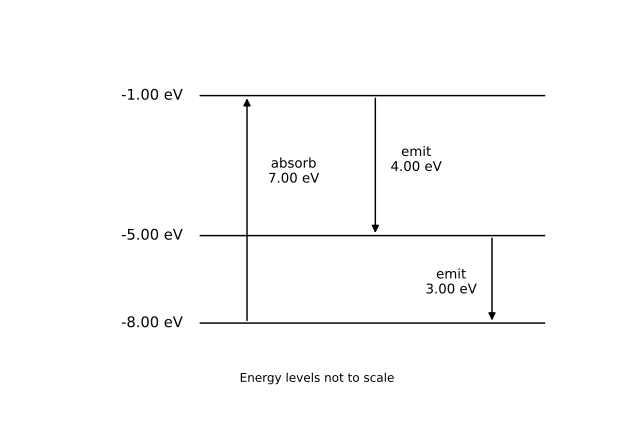
Part a: Draw the correct upward absorption arrow.
Part a: Draw and identify both downward cascade arrows.
Part b: Calculate the 4.00 eV transition wavelength.
Part b: Calculate the 3.00 eV transition wavelength and identify it as longer.