Q99 · Practice questionComplex unfamiliar7 marks
QUESTION 99 (7 marks)
The energy profile shows a reversible reaction. Reactants have energy 40 kJ mol⁻¹, products 10 kJ mol⁻¹, and the uncatalysed transition state 110 kJ mol⁻¹. The dashed catalysed pathway peaks at 85 kJ mol⁻¹.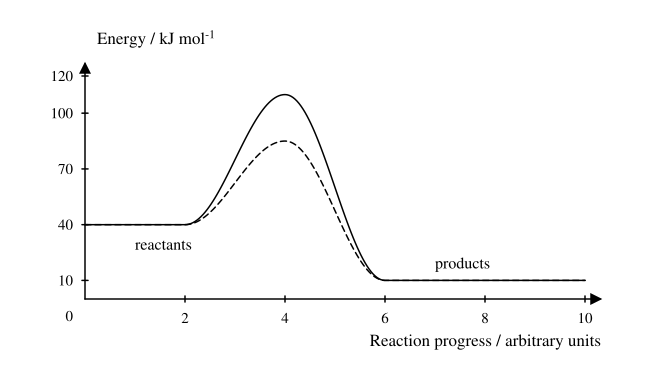
a) Calculate ΔH and both uncatalysed activation energies. [3 marks]
b) Calculate the catalysed forward activation energy and explain the effect on Kc at fixed temperature. [2 marks]
c) Predict how increasing temperature affects Kc, with justification. [2 marks]
WORKED SOLUTION
7 marksPractice marking scheme
ΔH = −30 kJ mol⁻¹; forward Ea = 70; reverse Ea = 100; catalysed forward Ea = 45. Catalyst leaves Kc unchanged. Increasing temperature decreases Kc for this exothermic forward reaction.
Energy differences are measured from the appropriate reactant level to the peak. Catalysts alter pathways and rates, not the reactant–product energy difference or equilibrium constant. Added heat favours the endothermic reverse direction, decreasing the product/reactant equilibrium ratio.
- Calculates ΔH = −30. [1 marks]
- Calculates forward Ea = 70. [1 marks]
- Calculates reverse Ea = 100. [1 marks]
- Calculates catalysed forward Ea = 45. [1 marks]
- States catalyst leaves Kc unchanged at fixed temperature. [1 marks]
- Predicts Kc decreases on heating. [1 marks]
- Uses exothermic forward/endothermic reverse reaction to justify. [1 marks]
Practice question aligned to the current QCAA syllabus; review the worked solution and marking criteria.
View the QCAA syllabusHow many marks did you earn?
Compare your working with the guide above.