QCEVault

Chemical equilibrium — Question 19

QCAA 2025, Paper 1 · 1 mark

Q19 · 2025 · Paper 1Unclassified1 mark

QUESTIONS 19–20 Questions 19–20 refer to the reversible chemical reaction and enthalpy level diagram shown.
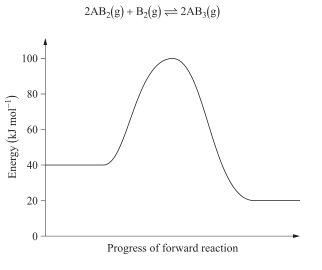
Chemistry question figure

QUESTION 19

Which statement is true for the forward reaction?

(A) Energy is a product.

(B) The reaction is endothermic.

(C) Enthalpy change (ΔH) is positive.

(D) Activation energy (Ea) is less than enthalpy change (ΔH).

Related questions

  1. Q7 · 2025 QCAA · Paper 1 · 1 mark
    QUESTION 7 Which of the following is exchanged with the surroundings when a chemical reaction reaches dynamic equilibrium? (A) gases (B) matter (C) energy (D) products
    Chemical equilibrium
  2. Q17 · 2025 QCAA · Paper 1 · 1 mark
    QUESTIONS 17–18 Questions 17–18 refer to the relationship between the concentration of nitrogen (N2), hydrogen (H2) and ammonia (NH3) in a closed system, as shown. N2(g) + 3H2(g)  2NH3(g) + heat NH3 Concentration (mol L−1) H2 N2 t1 Time (min)
    QUESTION 17 Determine the equilibrium law expression (Kc) for the reaction. [ ] 2 NH 3 (A) K = c [ ] [ ] N 3 H 2 2…
    Chemical equilibrium
  3. Q18 · 2025 QCAA · Paper 1 · 1 mark
    QUESTIONS 17–18 Questions 17–18 refer to the relationship between the concentration of nitrogen (N2), hydrogen (H2) and ammonia (NH3) in a closed system, as shown. N2(g) + 3H2(g)  2NH3(g) + heat NH3 Concentration (mol L−1) H2 N2 t1 Time (min)
    QUESTION 18 Determine the change applied to the system at t1. (A) N2(g) was added. (B) Pressure was increased. (C…
    Chemical equilibrium
  4. Q20 · 2025 QCAA · Paper 1 · 1 mark
    QUESTIONS 19–20 Questions 19–20 refer to the reversible chemical reaction and enthalpy level diagram shown. 2AB2(g) + B2(g)  2AB3(g) 100 80 Energy (kJ mol−1) 60 40 20 0 Progress of forward reaction QUESTION 20 Determine the activation energy (Ea) of the reverse reaction. (A) 20 kJ mol−1 (B) 40 kJ mol−1 (C) 60 kJ mol−1 (D) 80 kJ mol−1
    Chemical equilibrium