Q98 · Practice questionComplex unfamiliar6 marks
QUESTION 98 (6 marks)
An unknown acyclic carbonyl compound is either butanal or butan-2-one. It has molecular-ion mass 72 and no broad O–H IR band. Heated acidified dichromate changes orange to green. Oxidation of 0.360 g of the unknown gives 0.400 g of the corresponding carboxylic acid. Use molar masses: unknown 72.1 g mol⁻¹; acid 88.1 g mol⁻¹.
a) Identify the unknown and explain which evidence distinguishes the two candidates. [2 marks]
b) Name the acid product. [1 marks]
c) Calculate the oxidation percentage yield. [3 marks]
WORKED SOLUTION
6 marksPractice marking scheme
Butanal; its aldehyde group is oxidised whereas the ketone does not give the stated ordinary test. Product is butanoic acid. Yield = 90.9%.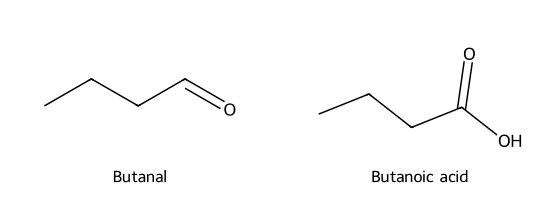
Both candidates have the same molecular formula and carbonyl IR class, so those observations do not distinguish them. Dichromate oxidation supports the aldehyde. Initial moles=; theoretical acid= g; yield=.
- Identifies butanal. [1 marks]
- Uses dichromate response to distinguish aldehyde from ketone. [1 marks]
- Names butanoic acid. [1 marks]
- Calculates unknown moles. [1 marks]
- Calculates theoretical acid mass. [1 marks]
- Calculates yield 90.9%. [1 marks]
Practice question aligned to the current QCAA syllabus; review the worked solution and marking criteria.
View the QCAA syllabusHow many marks did you earn?
Compare your working with the guide above.